Lakewood today is the sum of all the pasts that have shaped the landscape and the people who shared it.
The Long Beach Press-Telegram described election headquarters as “a scene of bedlam” when, at 3:15 a.m. on March 10, 1954, the last of the ballots for the incorporation of Lakewood and the election of a city council had been counted. Lakewood cityhood had won by a decisive, three-to-two majority.
Some incorporation supporters in the years that followed saw that night as a triumph of local government. Critics, however, saw the making of what they called a "phantom city."
Both the supporters and the critics of incorporation were equally right in one respect. The new city of Lakewood redefined the future of municipal organization in California. That change was so significant that it deserves the overworked adjective “revolutionary.”
Incorporation in 1954 wasn't the start of Lakewood's story, however. Lakewood's roots begin in the distant past.
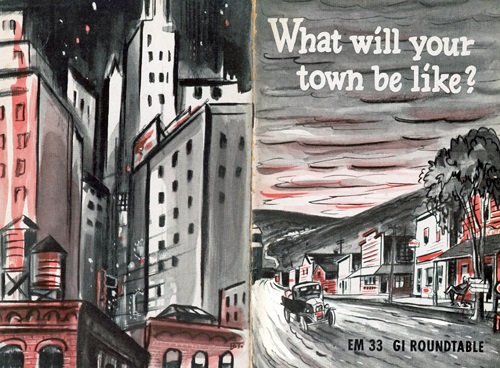 GIs in World War II were asked to consider what their post-war home would be like.
The incorporation of Lakewood in 1954 was unprecedented, but the kind of suburban community that Lakewood became was not unplanned.
Thinking about, writing about, and arguing about the homes of working men and women had been a feature of American social and political life for decades.
Communities very much like Lakewood had been predicted in the 1920s, when social reformers sought to get working-class Americans out of the crowded tenements and the ethnic ghettos of big cities and into single-family, suburban homes.
Fascination with housing issues wasn’t confined just to city planners. Magazines, newspaper editorials, and even Sunday sermons were part of a national conversation about the best way to build homes and make healthy communities for working people.
In the 1930s, the Roosevelt administration turned this national conversation into legislation that would reform the financing of home ownership and create national standards for home construction. A new age of home ownership had begun, to be interrupted by the war years between 1942 and 1945.
During the worst days of World War II, tens of thousands of soldiers and sailors read one of the War Department’s guides to post-war living in which peacetime aspirations were summarized as a small house in a suburban neighborhood. Under the GI Bill of Rights, signed into law in June 1944, veterand were promised the opportunity to have that kind of home. (That promise was not always kept, however.)
In the early postwar years, there was Levittown, developed by William Levitt in 1946 on Long Island. Levittown was the most written about and talked about suburban housing development in America, but not always favorably.
In Los Angeles County, the Panorama City and Westchester developments of the late 1940s, begun by Fritz Burns and Henry J. Kaiser, looked much like Levittown. These models of suburban development made a place for Lakewood in the imaginations of builders, bankers, government planners, and young men and women wanting a home.
Actually building Lakewood, fighting for its incorporation, and sustaining its civic life required much more than an optimistic imagination, however.
It has become something of a cliché to describe suburbs like Lakewood as the product of the economic, political, and social forces that contended for dominance in mid-20th-century America, as if the people living in Lakewood were spectators to their own history and not actively engaged in the practical work of city making.
That view is challenged by the narratives of the men and women who made Lakewood possible.
Lakewood's story contains dreams achieved and some aspirations still unfulfilled. It reveals trends in municipal government and urban planning and shows how some of those trends were redirected by Lakewood's early success. Lakewood's story also describes the economic engines that powered the city, as well as how Lakewood remained Lakewood even as the regional economy was transformed in the 21st century.
The city's story documents the durable character of the Lakewood community, but it also shows the effects of great change.
 Lakewood from the air in 1945
Native Americans, Spanish colonizers, Mexican rancheros, American entrepreneurs, the heirs of a millionaire “Copper King,” and thousands of young homeowners are part of Lakewood's history, but their stories always begin with the land itself.
It may seem less than celebratory, but the truth is obvious at a glance. The land of Lakewood is flat.
So flat that the average difference in height from the northwestern edge of the city’s 9.5 square miles to the opposite edge is less than four feet. Where other landscapes in Los Angeles County undulate and provide vistas, Lakewood declines to mar the level surface of the plain that lies between the Los Angeles and San Gabriel rivers.
If geography is destiny, then Lakewood was destined for flatness. (A closer look at the early landscapes of the Los Angeles Basin)
That isn’t to say that flat is bad. Flat is one of the reasons why it was possible to build thousands of Lakewood houses so quickly. Flat makes Lakewood a walkable city and a bikeable one. Flat puts everyone on the same footing. If you plan to look down on your neighbor in Lakewood, you’ll have to get a ladder.
Nor is flat uninteresting. A lot is going on under Lakewood. Beds of water, stacked like a clay, sand, and gravel layer cake, lie beneath the city. Rifts and uplifts fold some of these layers into long, underground hills. Some of those folds are sharply broken, as if cut by an immense knife. These faults show where earthquakes have shaken the land of Lakewood.
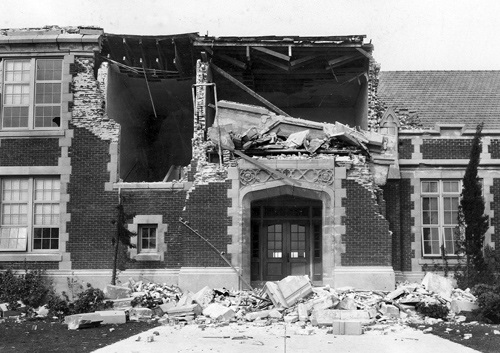 The 1933 Long Beach earthquake damaged many school buildings.
On March 10, 1933 at 5:54 pm, the Newport-Inglewood Fault erupted in a destructive earthquake centered just off the coast at Huntington Beach.
The magnitude 6.3 earthquake toppled buildings in Long Beach, Bellflower, Compton, and other communities in southeast Los Angeles County. More than 120 people died, largely from collapsed structures and falling debris.
The entire Los Angeles region is seismically active, and Lakewood, like many other cities in the southeast, was rocked in 1987 by the Whittier Narrows earthquake, the Landers and Big Bear earthquakes in 1991, and the powerful Northridge earthquake in January 1994.
The Newport-Inglewood Fault also is responsible for the range of hills that stretch from Newport Beach in Orange County to the Baldwin Hills. The most prominent nearby features are Signal Hill, Reservoir Hill (in Long Beach), and the Dominguez Hills.
These mark a boundary between two zones where underground water is found – the West Basin and the Central Basin. The Central Basin includes Lakewood and most of the cities of southeastern Los Angeles County.
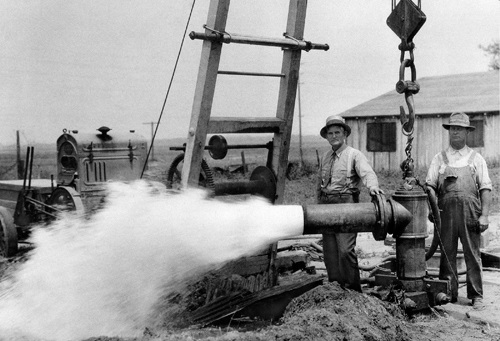 Artesian wells once flowed on the land that is now Lakewood.
Buried under the Central Basin is the plumbing that provides the water that Lakewood residents use. The source is invisible, unlike the better-known system of aqueducts that supplies the city of Los Angeles.
Beneath Lakewood – 1,000 feet or more – are zones (or strata) of sand and gravel separated by compacted clay. These layered formations extend for many miles, some of them stretching all the way from the foothills to the Pacific Ocean.
In a few places, some of these strata have been uplifted so that they are exposed, allowing rainwater and snowmelt from the mountains to flow into them, replenishing the underground water supply.
Water that enters the exposed strata may travel dozens of miles over many months or even years before returning to the surface, where the water may form a natural spring or lake. If the water-bearing layer is never exposed at the surface, the water will continue underground all the way to the coast, where its fresh water mingles with the Pacific’s salt water.
The strata that bear water are called aquifers, and Lakewood sits above several aquifers from which water can be drawn using electric pumps.
In the past, some of these aquifers carried such a large volume of water so close to the surface that when tapped by farmers for irrigation in the 1880s, the water gushed from the ground in the form of an artesian well.
Artesian wells, which don’t require a pump to bring water to the surface, gave their name to the city of Artesia.
There once were famous artesian wells in Lakewood, drilled by a real estate promoter and Civil War veteran named Edward Bouton. Some of his wells tapped an aquifer a short distance east of the Lakewood Golf Course. (A closer look at Edward Bouton and his wells) By 1903, these wells were supplying Long Beach’s municipal reservoirs.
Taking note of its underground source, the Seaside Water Company proudly marketed its product as unique. “The purity and softness and healthfulness of the Long Beach water supply coming from the Bouton wells 750 feet down is a matter of more than local renown. This flowing water is delivered in its virgin purity without contamination and from 750 feet in the bowels of the earth, and it never sees the light of day until it flashes and sparkles from the faucets in Long Beach homes…” (The company admitted that its water looked yellowish, but insisted that it had medicinal properties.)
There are no artesian wells in Lakewood today, largely because the region’s aquifers have been heavily used, first for agricultural purposes and later to supply water to homes and industries.
Water for customers in the western part of Lakewood is still drawn from the city's own wells, although electric pumps are needed to bring the water from hundreds of feet below the surface. Much of the water in Lakewood’s wells comes from the rainwater and snowmelt that percolates into the aquifer system.
Water for customers in the eastern part of Lakewood is supplied by an investor-owned water company.
Additional water for Lakewood comes from the Colorado River through the California Aqueduct. This water is injected into the aquifer system under pressure near the coast to prevent salt water from intruding into the Central Basin. Also, processed reclaimed water is pumped over spreading basins along the upper San Gabriel River. This water reenters the aquifer system to be naturally filtered as it travels south to Lakewood and the city's wells.
Bouton's well and the original Bouton Lake
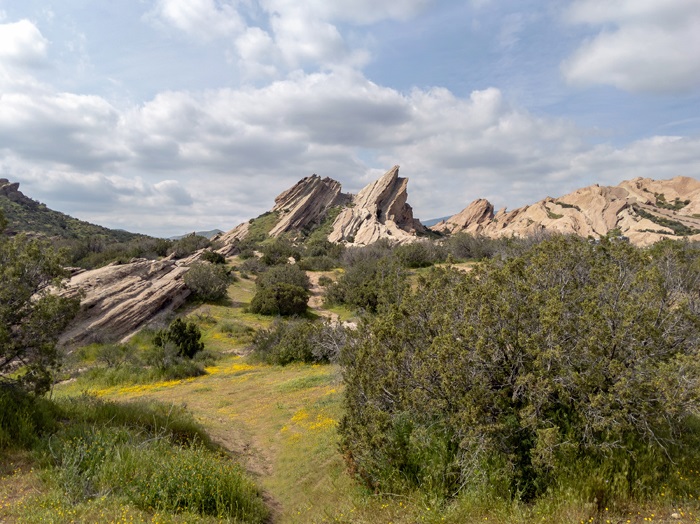 Chaparral once covered the foothills above the Downey Plain.
The nine-mile-wide Downey Plain that covers Lakewood’s plumbing is a part of the much larger, 420-square-mile Coastal Plain that runs for about 50 miles from central Orange County to the Santa Monica Mountains and inland 12 to 20 miles.
Behind the Coastal Plain is a series of valleys – the San Gabriel Valley, Pomona Valley, La Crescenta Valley, and San Fernando Valley. Over them stand the higher elevations of the Puente Hills, the Santa Monica Mountains, and San Gabriel Mountains.
The eastern part of the plain was lifted up over tens of thousands of years from the floor of a shallow sea that once covered the entire area. The western side of the Coastal Plain, including Lakewood, is a piece of continental shelf, but it once was significantly higher than it is today. Over time, Lakewood's side of the plain sank, allowing river-borne sand and gravel to fill ancient valleys cut by rivers when the area had a higher profile.
The underground and above ground landscapes of Lakewood are connected. The distribution of gravel, sand, and clay under the plain reflects the changing levels of the seashore and the action of rivers that carried sediment from the foothills and mountains that enclose the Coastal Plain on three sides.
According to the United States Geologic Survey, “Several past cycles of advance and retreat of the sea have been identified. Each cycle leaves a signature in the sediments by producing distinctive layering or bedding, evidence of erosion, and telltale assemblages of fossils.”
Samples taken from a USGS monitoring well in Long Beach in the 1990s revealed shells and pieces of ancient wood. “This sediment layer,” the USGS geologists noted, “although found hundreds of feet below the surface and several miles inland from the present shoreline, is an ancient beach deposit … dated at about 300,000 years old. The ancient beach is now well below the current ground surface because the Los Angeles Basin has subsided with time as it filled with sediment.”
Water – flowing in enormous quantities from seasonal rivers that sprang from geologically young mountains – was the agent that spread sand, clay, and gravel over the valleys of ancient Los Angeles, leveling the surface and burying the aquifers. The gently sloping contour of Lakewood is a product of repeated flooding, going back tens of thousands of years, as nameless rivers that preceded the Los Angeles, San Gabriel, Rio Hondo, and Santa Ana rivers poured out onto the plain.
Lakewood’s topography was made by floods; its aquifers were buried by floods. You might say that Lakewood, from top to bottom, was formed by water.
 Expert and artful basket weaving is a Kizh-Gabrieleño tradition.
Exactly when the ancestors of today’s Native Americans arrived on the Downey lain isn’t known. Based on recent archaeological finds in Central and South America, their arrival was at least 15,000 years ago and perhaps far longer ago than that.
The early residents of the plain lived in a rapidly changing environment, wetter during long periods and more prone to drought in other eras. Food sources changed as the climate and vegetation changed. The first human populations on the Downey plain may even have driven some large game animals to extinction, forcing the inhabitants to develop alternative food gathering strategies. New technologies also developed among Native communities, including hunting tools like the bow and arrow, as well as domestic improvements like basketry and the preparation of acorn meal.
The inhabitants of the plain changed as well. The Native Americans that Europeans first encountered had arrived at least 300 years before 1500, displacing or absorbing earlier inhabitants. Based on studies of Native languages, the new arrivals had themselves been displaced from homelands that may have been outside today’s California.
Some of those who lived on the Downey plain may have called themselves the Kizh (pronounced Keech), indicating that they were the Willow House People. Some were later named Gabrieleños because of their association with the Mission San Gabriel Arcángel. Others may have called themselves the Tongva.
European explorers, missionaries, and settlers did a poor job of recording the languages, beliefs, and histories of the inhabitants of the plain before their original way of life was wiped out by disease and forced labor.
Spanish missionaries in the mid-1700s noted that the region’s Native people hunted and fished in the marshes formed on the plain during wet seasons. Europeans who visited seaside villages wrote about well-made plank boats called ti’at. Reports to the Spanish government in Mexico described a decentralized network of more than thirty communities in the Los Angles basin that traded with more distant communities. Each community was a cluster of dome-shaped dwellings made of willow branches and reeds.
Pre-colonial, Indigenous communities are the source of many of the place names of the Los Angeles Basin: Pacoima, Cahuenga, Tujunga, Topanga and Cucamonga among them.
See a special Lakewood CityTV program that highlights the Native American communities that made the Lakewood-Long Beach area their home; among them are the Kizh-Gabrieleño people. For more information about Native Americans and their histories, go to the website of the National Park Service.
The immediate Lakewood area, based on the limited archaeological record, was not a center of Native life. Nearby by, however, were two important sites – Tibihangna and the ceremonial center of Puvuungna.
Tibihangna was roughly where today’s Rancho Los Cerritos is located in northwest Long Beach. Puvuungna covered the crown of the hill where today’s California State University Long Beach and Rancho Los Alamitos are located.
The people of Tibihangna and Puvuungna first appear in the records of the Spanish voyager and explorer Juan Rodríguez Cabrillo in 1542. He reported that ocean-going ti'at from a large village had ventured out to meet his ship. In 1602, Sebastián Vizcaíno briefly stepped ashore near the mouth of the Los Angeles River and named his landing place San Pedro (because it was the Catholic feast day of Saint Peter).
In 1769, the Spanish returned with every intention to hold Upper California against the expansion of Russian and British settlements further north.
To lead the California expedition, the authorities in Mexico City turned to Captain Gaspar de Portolà. He had served as a soldier in Italy and Portugal before being appointed governor of Las Californias in 1768. He volunteered to lead an expedition planned by Don José de Gálvez, the Spanish Inspector General of Mexico. The goal of the expedition was to find an overland route to Monterey Bay.
Portolà was anxious to complete his assignment once his expedition reached San Diego. He went overland with a party of 63 soldiers and missionaries on July 14, 1769 and reached the vicinity of Los Angeles on August 2.
Portolà liked what he saw as he crossed the basin but he did not strike for the coast, where he might have passed through the Lakewood area. Instead, he continued inland, passing through the San Fernando Valley. Portolà never reached Monterey Bay and returned to San Diego disappointed that he had not achieved his goal. Despite this failure, the Portolà expedition demonstrated Spain’s resolve to hold California.
The establishment of Spanish rule had a military purpose (to extend Spanish authority northward), a religious purpose (to convert the native inhabitants to Catholicism), and a colonial goal (to ensure that converted Native Americans would become loyal Spaniards). In the eyes of the Spanish authorities, colonization and evangelization would bring the benefits of civilization to the wilderness they called Alta California.
Under the direction of Father Junípero Serra, the chain of Franciscan missions beginning in San Diego reached the Los Angeles area with the founding of Mission San Gabriel Arcángel in 1771. It was the fourth mission to be established by Serra.
The mission system that Serra imposed, while humanitarian in inspiration, required Native communities to be removed to the missions, sometimes by force, for religious instruction and communal labor. Almost immediately, the impact of European diseases and an unfamiliar way of life caused Native communities to collapse. Their language was replaced by Spanish, and their customs were rooted out. Thousands died from over-work and from tuberculosis, smallpox, measles and other diseases.
Some Native bands fled the missions. Some were hunted down and punished, often severely. Other bands revolted against their treatment. Rebellion led to harsh retaliation, more deaths, and further limits on the freedom of Native people.
So quickly were Native Americans reduced by these conditions that in the 25 years between the founding of the San Gabriel Arcángel mission and the founding of the San Fernando Rey de España mission n 1797, the Los Angeles basin had been emptied of its Native communities. By 1804, the religious and ceremonial center of Puvuungna appeared to be an abandoned hilltop. By then, the land that was to become Lakewood had passed to new possessors.
San Gabriel Arcángel Mission

Vast ranchos covered the Los Angeles Basin in the 1840s with orchards, vineyards, and herds of cattle.
The pueblo (village) of Los Angeles was founded about ten miles from Mission San Gabriel Arcángel in 1781 to reinforce Spanish control of Alta California and provide support for the military units that garrisoned Los Angeles. The new pueblo was resented by the mission's religious authorities, who regarded the establishment of a secular community as a distraction from the work of converting Native Americans.
Serra also feared that land given to settlers would interfere with claims for the same land on behalf of Native converts.
In 1784, Colonel Pedro Fáges, the Spanish governor of Las Californias, allowed retiring veterans of the military detachments under his command to take control of grazing land around the Los Angeles pueblo. José María Verdugo, who requested part of what is now Burbank and Glendale, was the first grantee. His use of the land was not yet outright ownership. That would come later.
A year later, Fáges received permission from the Spanish government to make more grants to army veterans, as long as these grants didn’t conflict with the San Gabriel mission or the rights of the Los Angeles pueblo.
With his authority confirmed, Fáges signed over additional grazing rights to Manuel Nieto, who received final confirmation of his grant in 1791. The Nieto grant consisted of all the land lying between the Santa Ana River and the San Gabriel River (which then flowed where the Los Angeles River now lies) and from the ocean to the road leading east from Los Angeles (roughly Whittier Boulevard). This huge area – over 160,000 acres called Rancho Los Nietos – is now occupied by the cities of Long Beach, Lakewood, Bellflower, Cerritos, Downey, Norwalk, and Santa Fe Springs, and parts of Whittier, Buena Park, and Garden Grove.
Nieto was said to be the richest man in California – not in money but in cattle and horses.
 Nieto retired from military service in 1795 and in the casual way of the period, allowed his herds of semi-wild horses and cattle to roam across the Los Angeles River to graze on the western side, much to the annoyance of Juan José Dominguez, Nieto’s neighbor. When Nieto died in 1804, his rancho passed undivided to his widow and his five children with his oldest son acting as manager. The heirs eventually fell out over management of the property and in 1833 petitioned José Figueroa, the governor of what had now become the Mexican province of California, to divide the land of the rancho among them.
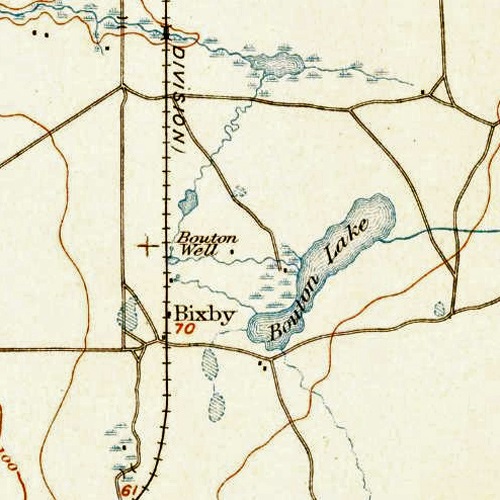
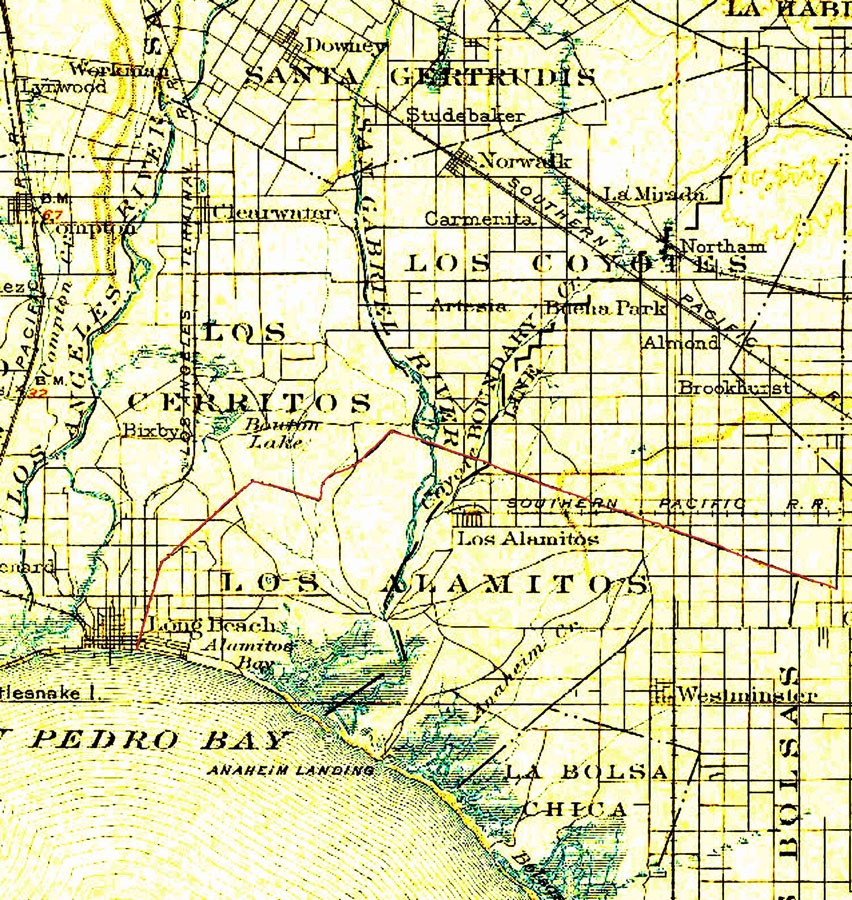
On this map from 1904, the jagged red line is the boundary between Rancho Los Cerritos and Rancho Los Alamitos. Bouton Lake is just below the word "Cerritos."
By then, the grants begun under Spanish rule had produced a scattering of ranchos on the Downey plain. Small adobe houses, workshops, and servants’ quarters clustered next to plowed fields and vineyards. In between were lonely miles of range land, marsh, and seashore.
In the pueblo of Los Angeles and at the port in San Pedro, the rancheros paid for manufactured items and luxury goods with blocks of beef tallow and bales of tanned hides culled from the rancheros’ immense herds of cattle. American and British ships carried the tallow and the hides back to the United States and England where the tallow became candles and the hides were made into shoes.
Figueroa satisfied the Nieto heirs in 1834 by dividing the rancho into five portions: the ranchos Santa Gertrudes, Los Alamitos, Los Cerritos, Los Coyotes, and Los Bolsas. The three ranchos that play a part in Lakewood’s history are Rancho Los Cerritos (The Little Hills Ranch), located in northwest Long Beach near what is now the Virginia Country Club; Rancho Los Alamitos (The Little Cottonwoods Ranch), with its headquarters atop the hill at the southern end of Palo Verde Avenue near what is now the campus of California State University Long Beach; and Rancho Los Coyotes (The Ranch of the Coyotes) which once included all of what is now eastern Lakewood. It's headquarters were in what is now Buena Park.

Today, Alamitos Avenue and the Los Coyotes Diagonal in Long Beach mark part of the line that divided Rancho Los Cerritos in the south and Rancho Los Coyotes in the north. Nieto’s daughter, Manuela Cota, received the five-square-league Rancho Los Cerritos on May 22, 1834. Her brother, Juan José Nieto, got the adjoining Rancho Los Alamitos.
Rafaela Cota, a Nieto descendant and inheritor of one-twelfth of Rancho Los Cerritos, married Don Juan (Jonathan) Temple in 1830. Temple was a Yankee merchant, a naturalized Mexican citizen, and a successful entrepreneur who was able to purchase Rancho Los Cerritos in 1834 from the other Nieto heirs at a cost of $3,025 in silver and an equal amount in general merchandise.
Temple, through his overseers and vaqueros (cowboys), grazed 15,000 cattle, 7,000 sheep, and 3,000 horses at Rancho Los Cerritos. Like other Yankees in Mexican California, Temple was more than a rancher. He was an accomplished go-between in two worlds – the pastoral world of the rancheros and the commercial world of Boston, Massachusetts and Manchester, England. That skill was an advantage for Californian Yankees when the United States declared war on Mexico in 1846.
When the war ended in 1848, Temple and Able Stearns, another Yankee and owner of the adjacent Rancho Los Alamitos since 1842, made themselves indispensable as money lenders, merchants, city officials, and interpreters of American customs to the formerly Mexican rancheros. Between 1849 and 1860, the two men became even wealthier as merchants and as suppliers of the beef, flour, and brandy (made from local grapes) that the miners of the Gold Rush craved.
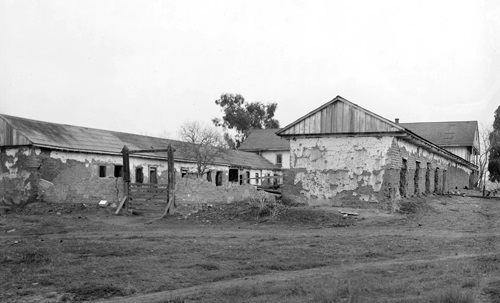 The Los Cerritos rancho in 1910
The prosperity brought by the Gold Rush pumped money into Los Angeles and kept the rancho system propped up after California became a state in 1850.
Los Angeles was only a small town then. The dispersal of agricultural settlements, reinforced by the rancho system, made it hard to develop the kind of civic structures that were weaving together pioneer settlements in other parts of the country.
Mocked as Los Diablos (The Devils) rather than Los Angeles (The Angels), the city reported a murder a day during the months when cattle drovers, teamsters from San Bernardino, and disappointed prospectors flocked to the city’s saloons. Native American laborers, often the target of violence, were at the bottom of the city's economic ladder, forced to work long hours for a daily meal and a quart of raw grape alcohol on Saturday nights.
The Civil War years (1861 to 1865) did little to change this pattern of life even as violent pro-Confederate and pro-Union politics kept Los Angeles a dangerous town.
The environment intervened to change ranchero life in the “famine years” between 1863 and 1864. Immense herds of cattle and horses vainly foraged on grass that had gone season after season with little rain. As the drought worsened and the grass withered, the herds died or were slaughtered by rancho owners.
In the end, many large landowners had nothing left but the mortgages they had signed during the drought years. Even Temple and Stearns were forced to sell. Stearns’ Rancho Los Alamitos was sold at a foreclosure auction in 1866 to Michael Reese, a San Francisco financier. That same year, Temple sold Rancho Los Cerritos to the firm of Flint, Bixby & Co. for $20,000 (or about seventy-four cents an acre).
Brothers Thomas and Benjamin Flint and their cousin Lewellyn Bixby had formed Flint, Bixby & Co. in 1854 to raise sheep in Northern California. They sent Lewellyn's brother Jotham Bixby to manage the company’s new southern branch in 1866. In 1869, Jotham bought a half interest in Rancho Los Cerritos and formed J. Bixby & Co. Rancho Los Cerritos herded as many as 30,000 sheep with an annual wool clip of 200,000 pounds. (A closer look at rancho days in the 1880s with Sarah Hathaway Bixby Smith)
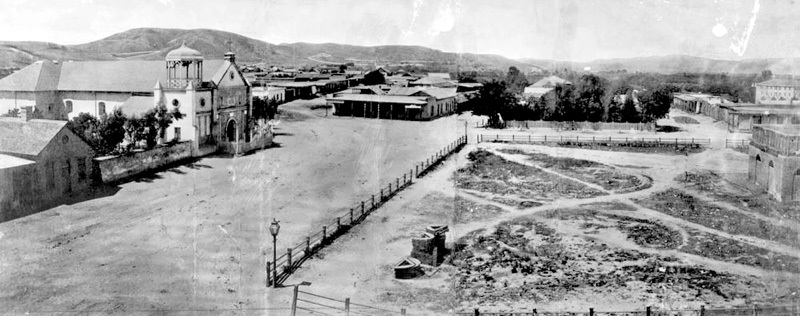 Los Angeles in 1860 was small, dusty, and violent.
Los Angeles, which had a population of just 5,726 in 1870, was one of the few incorporated cities in the county (which included what is now Orange County). A handful of small towns dotted the roads leading from Los Angeles and along the coast to San Diego. The transcontinental railroad eventually reached Los Angeles (by way of San Francisco) in 1876 spreading new towns along the tracks.
The 1880s began a curious period in the expansion of Southern California. Everyone with land to sell was convinced that the region was perfect for intensive agriculture, although the region lacked a reliable source of water for much of the year. Everyone also knew that Los Angeles County only needed settlers to make rancho land profitable.
One solution was the “agricultural colony” – the sale of rancho land to “colonists” (often entire communities of migrants) who would come to Southern California from eastern and mid-western states to become farmers, orchardists, vintners, and tradesmen.
Jotham Bixby sought to found an agricultural colony on part of his Rancho Los Cerritos as early as 1875 without much success. In 1881, he turned over a section of coastline to an inventive land agent named William Willmore who had ambitious plans for a new community where downtown Long Beach is today.
Willmore’s dream failed in 1884 when too few colonizers were willing to pay $400 an acre for the land. Long Beach eventually sputtered into existence under new developers, greatly helped in 1888 by the competition between the Santa Fe Railroad’s newly completed transcontinental rail line and the older Southern Pacific line, both of which now linked Los Angeles to the national railroad network.
Thousands of travelers made the rail trip west, lured by the low cost of travel and the marketing campaigns of the legions of salesmen who followed Willmore into the business of selling Southern California as a place to live.
Instant cities – often no more than wooden stakes stuck in an empty field to show where boulevards and house lots would go – were quickly laid out to lure buyers. Most of these speculative developments failed but a few survived to become the cities of Compton, Monrovia, Claremont, and Pomona.
The subdividing of Rancho Los Cerritos led John William Bixby, another cousin, to consider development of the adjacent Rancho Los Alamitos. John William Bixby had leased the rancho in 1878 and in 1881 (or 1883) purchased the land in partnership with Los Angeles financier Isaias Hellman and J. Bixby & Co. (a partnership that included his Bixby cousins and Flint, Bixby & Co.).
John William Bixby died suddenly in 1887 with plans to develop a portion of Rancho Los Alamitos as a seaside resort already in progress. In 1891, the rancho was broken up – one-third to John Willim Bixby’s heirs, another third to Hellman, and the final third to J. Bixby & Co . The J. Bixby & Co. parcel became an asset of the Bixby Land Company.
The Bixby Land Company began investing in a new agricultural technology to extract sugar from sugar beets. But the economic depression of the 1890s made it hard to raise the money needed to set up the facilities to produce and refine beet sugar. The Bixby Land Company turned to William A. Clark of Butte, Montana, and his brother, J. Ross Clark of Los Angeles, exchanging Rancho Los Alamitos land for the sugar processing plant the Clarks would finance and operate.
The company had found an investor with very deep pockets. William A. Clark was among the richest men in America and a powerful figure in Montana politics. He owned a lavish house on Fifth Avenue in New York and homes in France, Santa Barbara, and Los Angeles. He inadvertently created the town of Las Vegas (located in Clark County) when he built a spur rail line to service his holdings in Nevada.

William A. Clark was one of the nation's richest men.
In 1953, a reporter from the Long Beach Press Telegram sat down with 78-year-old C. J. (Gus) Strodthoff, who had been an employee of the Clark brothers and had seen their land go from fields to thousands of new homes. Strodthoff remembered William A. Clark as a smart businessman who “had interests in every state in the Union: wire works, copper and gold mines, newspapers, railroads, and lumber mills. He built the railroad from Terminal Island. He was once offered $100,000,000 for his United Verde Copper Co. at Jerome, Arizona, but he refused it.”
William A. Clark had little to do with sugar beets. J. Ross Clark represented his brother in his ranching and farming businesses. The Clarks acquired 1,000 acres from the Bixby Land Company to lease to prospective beet farmers and built a mill across the San Gabriel River to process the farmers' sugar beets. To expand beet production, the Clarks purchased 8,139 acres of former rancho land for $405,000 in 1897. The land extended from Signal Hill to what is now Bellflower and from Cherry Avenue to the San Gabriel River.
In 1904, the site of the future Lakewood passed to the Clarks’ newly formed Montana Land Company. The Clark brothers called their farming operation the Montana Ranch.
Sugar beets for the Los Alamitos mill were gown on 2,000 acres of the Montana Ranch, Gus Strodthoff remembered, with the remainder of the acreage for raising alfalfa and pasture for dairy cows and sheep. Children of farm families went to the Llewellyn School, a frame structure built at Carson Street and Woodruff Avenue in 1897.
The Montana Ranch offices, a barn, a blacksmith shop, a harness shop, a cook house, a bunkhouse for 40 ranch hands, and a hay mill were located beneath eucalyptus trees (a few still standing) along what is now Arbor Road west of Woodruff Avenue.
By the 1920s, the Montana Ranch cultivated 1,500 acres of sugar beets and 2,000 acres of barley and alfalfa with almost 3,000 acres of vegetable farms, dairies, hog sheds, and pastures. The Los Angeles Times, in an admiring article, noted that “more than 7,000 hogs are maintained on the holding. Seventy-one wells and pumps furnish irrigation water. There are over 1,000 milk cows on the place, dairying being one of the principal activities. Before the tractors entered the field, as many as 500 horses were needed, but now there are only 65.”
 The San Gabriel River, dry most of the year, could become a raging torrent after winter rains.
The Lakewood area changed greatly after 1890. Levees to protect downtown Los Angeles and its southern suburbs from flooding had begun to straighten and confine the Los Angeles River. (A closer look at flooding and Lakewood)
Agricultural communities, including Bellflower and Clearwater, expanded along electric trolley lines from Los Angeles to Orange County. Long Beach became a popular tourist destination. The opening of the Panama Canal in 1915 greatly boosted local industries. Oil was discovered at Huntington Beach (1920), Santa Fe Springs (1921), and Signal Hill (1921).
Only ten months after completion of its first oil well, Signal Hill was covered with 108 wells producing 14,000 barrels of oil a day. By the fall of 1923, 259,000 barrels of crude oil were being pumped from nearly 300 wells. Real estate development picked up as longshoremen and oil workers poured into Long Beach, Wilmington, and San Pedro.
When William A. Clark and his brother J. Ross Clark died (in 1925 and 1926 respectively), management of the Montana Ranch passed to their nephew, Clark J. Bonner, who was a Los Angeles business executive. When the Clarks' Los Alamitos sugar mill closed in 1926 due to declining profits, Bonner considered how the local real estate boom would affect his family's holdings.
Bonner initially planned an industrial development attached to the new Long Beach Municipal Airport, but the stock market crash in October 1929 ended those plans. Instead, Bonner envisioned turning part of the Montana Ranch into a suburb for a growing Long Beach. He filed a plan for subdividing the ranch in 1930.
Bonner’s new subdivision was a leisurely automobile commute from downtown Long Beach and removed from the smells and noise of the oil fields around Signal Hill.
Bonner turned to developer Charles B. Hopper to subdivide the land and sell house lots. In August 1932, the Los Angeles Times announced “Huge New Tract Launched; 9,000 Acre Development Near Los Alamitos Being Built Around Golf Course Project.”
Bonner picked a name for his project that resonated with his family’s elite background, naming the new subdivision after the fashionable winter resort of Lakewood, New Jersey where William A. Clark, along with the Rockefellers and Goulds, had built estates at the end of the 19th century.
The social heart of the new suburb was to be a golf course and a clubhouse for the use of the surrounding homeowners. The golf course would be laid out over land that had once been used by the Cerritos Gun Club, including the boggy remains of Bouton Lake, originally constructed by Thomas Stovell, superintendent of the Bouton Water Company.
Although Lakewood and the rest of the Montana Ranch were relatively near Long Beach, they were outside the boundaries of the city. Bonner’s land was unincorporated county territory. Its local government was the Los Angeles County Board of Supervisors, 25 miles away in downtown Los Angeles.
Bonner and the city of Long Beach had an understanding, however, that Bonner's Lakewood was within the orbit of Long Beach's political and business interests. The power brokers of Long Beach assumed that Bonner's subdivision would be part of Long Beach one day.
 The Lakewood community gathered at the golf course clubhouse in the 1930s.
Bonner and Hopper drew up a subdivision plan that emphasized an unusual concept. One-acre and half-acre lots in the new Lakewood Village tract were marketed in as back-to-the land “farm homes.” Smaller, 120-by-150-foot lots were called “semi-sustaining garden home” sites.
Lakewood Village sales brochure proclaimed “Under this new deal in city development, it would be possible for a Lakewood Village resident…to produce on his land enough fruits, vegetables, poultry and rabbits to care for his family almost exclusively on a year-round basis. With the city convenience of Long Beach just a few minutes away and industrial centers in close range, a family man can work part-time for cash income and devote part-time to food cultivation.” The "farm homes" of Lakewood Village were a response to the Great Depression that had begun in 1929.
Bonner completed the promised golf course and clubhouse, built in the popular Spanish Colonial Revival style and named La Casa de Buenos Amigos (The Home of Good Friends). William P. Bell (co-designer of courses at the Bel-Air, Riviera, Virginia, and Los Angeles country clubs) laid out the course.
In October 1934, after lots had been graded, the sales office of Lakewood Village opened, but few prospective buyers were prepared to build. The nation was in the worst years of the Great Depression, and the entire region had been rocked on March 10, 1933 by the Long Beach Earthquake.
Lakewood soon gained another attraction for potential buyers. After the Long Beach Earthquake demolished the part of the Wilson High School campus that housed Long Beach City College, new school buildings went up on 27 donated acres of Bonner's subdivision, opening in 1935. (The neighborhood was still so rural that the college mailing address was “Route No. 1, Clark and Carson Streets.”).
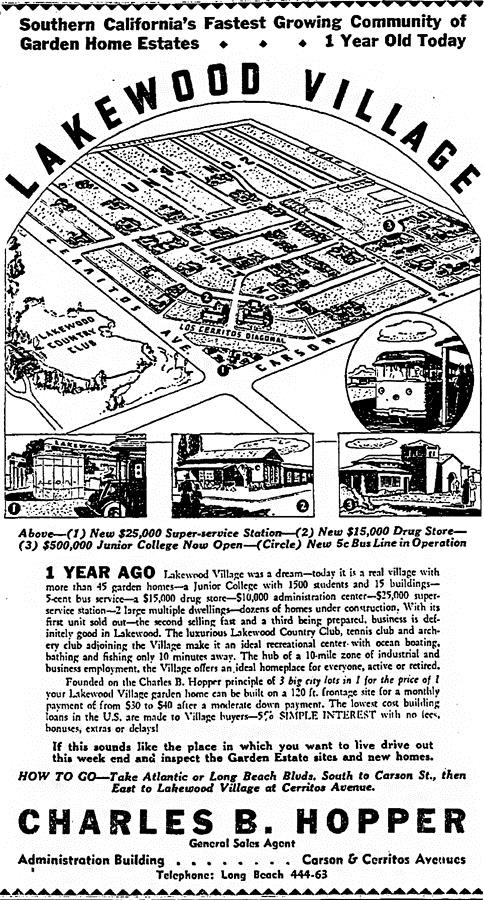 Lakewood Village in 1935. Cerritos Avenue would become Lakewood Boulevard.
On Bonner’s orders, no sidewalks were built in Lakewood Village in order to maintain its rural ambiance. With the support of village businesses, Bonner succeeded, according to the Long Beach Press-Telegram, in having the name Cerritos Avenue changed to Lakewood Boulevard.
The houses of Lakewood Village might be built by the owner himself or put up by a building contractor. In 1934, noted Los Angeles architect Wallace Neff showed how with a model Honeymoon Cottage at 4519 Village Road.
John Davies, the first Lakewood Village resident, moved into his new home at 4244 Pepperwood Avenue in the spring of 1935. Classes had already begun at the nearby campus of what was then called Long Beach Junior College.
“Farm homes” and house lots in Lakewood Village did not sell very quickly. By 1936, only 50 lots had been sold. A few streets had been laid out with names like Whitewood, Graywood, and Sunfield. Clark Avenue, named for the deceased Copper King, ended almost before it began.
In 1936, Bonner and Hopper offered an option for more affluent homebuyers: a neighborhood of estate-sized building sites along Lakewood Drive overlooking the golf course. Very few lots in the Lakewood Country Club Estates were sold, however.
By 1940, Lakewood Village had just 2,058 residents, even though house lots sold for only $700. It wasn't until 1941 that Lakewood Village began to grow with the support of federal home loan programs and the completion of the Douglas Aircraft plant.
Civic institutions also grew, largely through the efforts of the Lakewood Chamber of Commerce. Lakewood Village residents had formed a volunteer fire department in 1937. (The volunteers were replaced by county firefighters in 1945.) Churches and social clubs flourished. A utility district was formed in 1940 to pay for Lakewood's connection to the county sewer system. (Under pressure from Village residents, the district was dissolved in 1946.)
Fears of conflict with Japan prompted the War Department in 1939 to step up defense production on the West Coast, where armaments would be close to Pacific ports.
Army General Henry “Hap” Arnold convinced Clark Bonner to provide land for an Army Air Corps base next to Long Beach’s municipal airport. Bonner also sold 200 acres of adjacent farmland to the Douglas Aircraft Company to build an ultra-modern, $28.8 million, aircraft assembly plant. (A closer look at Douglas Aircraft and Lakewood)
Ground was broken in November 1940, with the plant’s dedication in October the following year.
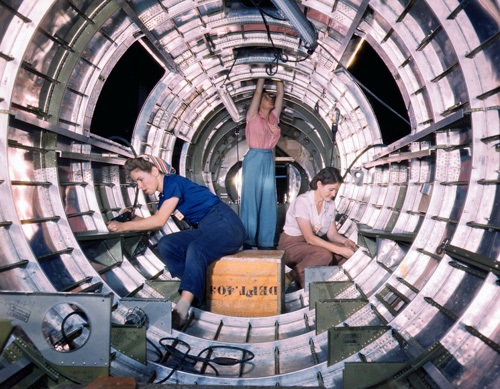 By 1944, most of the workers at the Douglas plant were women.
Next, Bonner turned to Walker and Lee Real Estate to develop the first mass-produced residential tract in Lakewood. The homes were built north of South Street.
The tract was called Mayfair, but it earned the nickname Radio Park because its street names honored broadcast personalities (Jimmy) Fidler, Hedda (Hopper), (Jean) Hersholt, (Gene) Autry, and (Al) Pearce and radio characters Dagwood (Bumstead), and Lorelei (Kilbourne)
There were other builders supplying homes to the growing force of workers at Douglas Aircraft. John Griffith and Herbert C. Legg (later a county supervisor) began building the 1,100 homes of the Lakewood City tract (north and south of Carson Street and east of Bellflower Boulevard). But these new tracts were not enough to house all the defense workers pouring into Long Beach. It was common for homeowners in Mayfair, for example, to rent a room to a Douglas worker to ease some of the housing shortage.
By the end of World War II in 1945, there were 3,500 homes in Mayfair, the Lakewood City tract, and Lakewood Village.
The 450 homes of Lakewood Gardens along Lakewood Boulevard were added in 1947, built by developer Paul Trousdale. He also built a clubhouse and a swimming pool for use by residents, still managed by the Lakewood Gardens Civic Association (said to be the oldest volunteer homeowner association in California).
Despite the construction boom, much of the Lakewood area had hardly changed. Modest houses were still surrounded by farmland leased to tenants who had been mostly Japanese-American farmers until war with Japan forced them into internment camps in 1942. Anglo and Latino farmers took their place during the war years.
The men and women who owned or rented houses in the Country Club Estates, Lakewood Village, Mayfair, and the Lakewood City tract were supposed to be Caucasian (white) and non-Jews. The Montana Land Company inserted restrictive covenants in the deeds of all the properties it sold. As the sales literature for the Lakewood Country Club Estates pointed out in the 1930s, these restrictions were of “an all-inclusive nature.”
Restrictive covenants were common throughout Southern California and in much of the nation. The Lakewood area was not unique. (Learn more about Lakewood's commitment to diversity and inclusion.)
Ads in the Long Beach Press-Telegram made a point of noting which new homes were in an “FHA restricted” neighborhood, where housing segregation was encouraged by federal policy. Throughout Los Angeles County, federal housing agencies had "red lined" existing neighborhoods that were racially mixed, preventing home buyers from getting federally-backed mortgages.
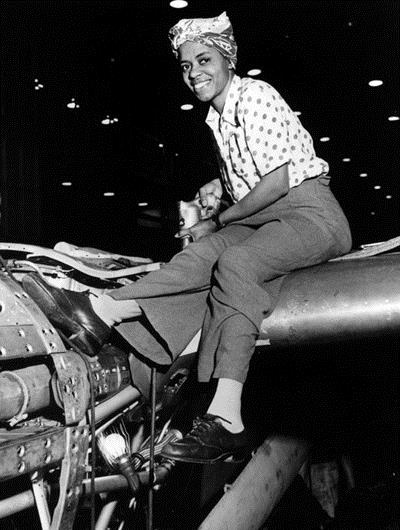 When the war ended in 1945, Black employment quickly faded.
Discrimination affected the workforce as well. In the war year of 1943, Douglas Aircraft had 2,200 Black workers. Northern American Aviation had 2,500, and Lockheed Vega had 1,700. But after 1945 and with the end of war production, the proportion of Black workers at North American dropped from 7 percent to 3 percent and from 8 percent to 1 percent at Douglas.
With the war over, Bonner began making plans to expand home construction in Lakewood for the thousands of veterans who were expected to head to California.
In 1944, Hopper and Bonner drew up a development plan that was remarkably similar to the Lakewood of today. Those dreams were cut short in late 1947 when Bonner, still in his fifties, died suddenly of a cerebral hemorrhage.
In 1949 and facing an unfavorable tax situation, Bonner’s widow Violet sold the Montana Land Company’s remaining 3,385 acres to the newly formed Lakewood Park Corporation.
Today, most traces of Clark Bonner's role in developing Lakewood have disappeared. The Montana Ranch offices and barns on Arbor Road were razed in the 1950s. A few of the ranch's eucalyptus trees remain near the offices of the Lakewood Water Resources Department.
Bonner’s memorial plaque at the first tee of the Lakewood golf course, naming him the “Father of Lakewood,” was put in storage when the clubhouse and golf course were remodeled in the 1980s. In 1990, Bonner’s grandson searched for his grandfather’s plaque. He was told that no one knew where it was. Through his efforts, a new plaque honoring Bonner was dedicated in 1993.
Sarah Hathaway Bixby Smith grew up on the ranchos Los Cerritos and Los Alamitos in the 1880s, when Long Beach was mostly fields and the wide valley between the Los Angeles and San Gabriel rivers (where Lakewood is situated today) was grazing land for thousands of sheep.
Sarah and her Bixby and Flint uncles and cousins shared a time and place that was gone before Lakewood was ever imagined, but Sarah’s “adobe days" linger at the Rancho Los Cerritos and Rancho Los Alamitos.
Sarah first wrote about her childhood in a memoir published by the Historical Society of Southern California in 1920. In her recollection, the family business of sheep ranching was the most significant fact of her young life.
The fun of life was at the sheep ranches, the Alamitos or the Cerritos, at each of which lived an uncle and aunt and some double cousins, and at which I made long and frequent visits. … Sheep, however, were the main interest. We ate sheep, smelled sheep, saw sheep, heard sheep, talked sheep; we lived, moved and had our being in, for and by sheep. There were sometimes as many as thirty thousand on this ranch (Los Cerritos) alone. We had got into the business in the early days of our being in California, long before I was dreamed of.
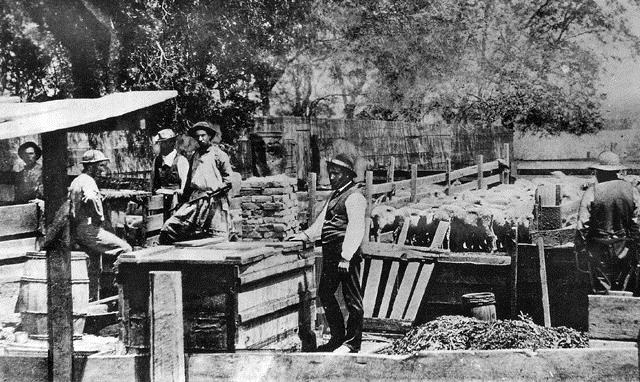 Sheep dipping at Rancho Los Alamitos in the 1870s
My father, Llewellyn Bixby, and two cousins, Benjamin and Thomas Flint, all young men in their twenties, came from Maine by way of the Isthmus of Panama to California, reaching San Francisco on the S.S. Northerner on July 7, 1851.
After a brief attempt at gold mining, the Bixby and Flint cousins turned to sheep raising, bringing a herd of more than 2,000 sheep from the Midwest to Southern California overland. They prospered and family members eventually purchased both the Cerritos and Alamitos ranchos. Sarah Bixby remembered the hard lives of the herders and the work of the twice-yearly shearing.
Most of the sheep … lived out on the ranges in bands of about two thousand under the care of a sheepherder and several dogs. These men lived lonely lives, usually seeing no one between the weekly visits of the man with supplies from the ranch.
Twice a year, spring and fall, the sheep came up to be sheared, dipped and counted. Father usually attended to the count himself, as he could keep tally without confusion. He would stand by a narrow passage between two corrals, and as the sheep went crowding through he would count and keep tally by cutting notches on a willow stick. As soon as the shearing was well under way the dipping began. This was managed by the members of the family and the regular men on the ranch. In the corral east of the barn was the brick fireplace with the big tank on top where the "dip" was brewed, scalding tobacco soup, seasoned with sulfur, and I do not know what else. This mess was served hot in a long, narrow, sunken tub, with a vertical end near the cauldron, and a sloping, cleated floor at the other. Into this steaming bath each sheep was thrown, it must swim fifteen or twenty feet to safety, and during the passage its head must be pushed beneath the surface. How glad it must have been when its feet struck bottom at the far end, and it could scramble out to safety. How it shook itself, and what a taste it must have had in its mouth. I am afraid Madam Sheep cherished hard feelings against her universe. She did not know that her over-ruling providence was saving her from the miseries of a bad skin disease.
Now the sheep are all gone, and the shearers and dippers are gone, too. The pastoral life gave way to the agricultural and that in turn to the town and city. There is Long Beach. Once it was cattle range, then sheep pasture, then, when I first knew it, a barley field with one shed standing about where Pine and First streets cross. And the beach was our own private, wonderful beach; and we children felt that our world was reeling when the beach was sold and called Willmore City.
Nobody now knows what a wide, smooth, long beach it was. It was covered with shells and piles of kelp and a broad band of tiny clams; there were gulls and many little shore birds, and never a footprint except the few we made, only to be washed away by the next tide. Two or three times a summer we would go over from the ranch for a day, and beautiful days we had, racing on the sand or going into the breakers with father or uncle …
All these things happened once upon a time in the long ago, and now we children are all grown up, and grandfather, father and mother and uncles … live only in the changeless land of memory.
From Annual Publications of the Historical Society of Southern California, 1920, pages 63-74
The war in Europe in 1939 turned Southern California into the nation’s arsenal. The expansion of Navy facilities added 50,000 military men and their dependents to the population of the Los Angeles/Long Beach region. The shipbuilding industry hurriedly expanded and eventually employed more than 100,000 workers, many of them at the Long Beach Naval Shipyard.
The most important defense contractor was the Douglas Aircraft Company, whose 1.5-million-square-foot plant next to the Long Beach municipal airport began production in late 1941. Douglas workers delivered their first C-47 transport plane to the Army just sixteen days after the December 7, 1941 attack on Pearl Harbor.
Designed by the architectural firm of Taylor and Taylor, Douglas' Long Beach facility was the country’s first “blackout plant.” The plant's 11 windowless buildings featured lightproof doors and air-conditioning, making it one of the first air-conditioned industrial facilities in the nation. To protect workers and vital machinery, the steel frame structure was lined with metal siding, and the entire plant was camouflaged to make it appear from the air to be a tract of suburban houses.
In November 1941, Douglas employed just 7,723 workers. An estimated 47,250 were building planes by May 1943. Approximately 57 percent of them were women. By the end of the war, 87 percent were women – the highest proportion in the country for an aircraft production facility.

General Eisenhower called the Douglas C-47 one of four “Tools of Victory” that won World War II.
The plant built more than 4,000 Douglas C-47 transport planes, 3,000 heavy bombers under license from Boeing, and more than 2,000 Douglas light bombers. The adjacent Long Beach Municipal Airport was the home of the Army Air Transport Command's ferrying division, which included a squadron of 18 women pilots commanded by Barbara London. They flew new Douglas planes to military bases across the nation.
After the war ended, most war plants were sold to their operators, usually for a fraction of their construction cost. In late 1946, Douglas purchased the Long Beach plant for less than $4 million.
The end of the war also brought an end to wartime employment. Some plants closed, and Douglas laid off all but 1,200 of its workforce. “The future is as dark as the inside of a boot,” company founder Donald Douglas is quoted as saying. But military procurement picked up later in the decade, and by the start of the Korean War in 1950, Douglas Aircraft in Long Beach was busy assembling Globemaster transport planes and the Skyhawk bomber.
By 1956, the company employed 22,000 people with a payroll of approximately $100 million.
In 1958, after enormous effort, Douglas produced its first jet airliner – the famed DC-8. But even then the company was losing its lead as the nation’s principal commercial aircraft supplier. Boeing was becoming dominant with its 720, 727, 737, and 747 models. The DC-8 remained extremely popular, however, as did the DC-9, which went into service in 1965.
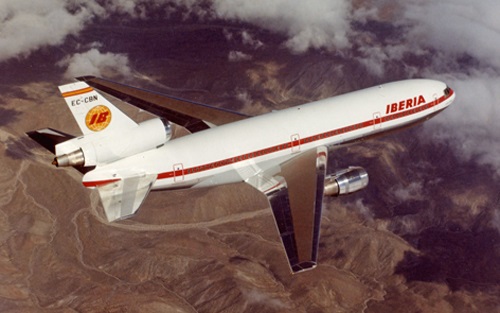 DC-10 jetliners were among the last built by Douglas Aircraft in Long Beach.
In 1966, Douglas suffered a second-quarter loss that exceeded $3.4 million. The company’s stock plummeted, and dividends were suspended. Facing more financial reverses, Douglas agreed to merge with St. Louis-based McDonnell Aircraft Corporation.
The merger was completed in April 1967, forming the McDonnell Douglas Corporation (MDC). At one point in the mid-1970s, one in ten Lakewood households depended on a paycheck or pension from MDC.
MDC’s first major project was the DC-10 wide-body airliner, a plane that earned, unjustly some say, a poor reputation. In the 1970s and early 1980s, the company introduced other models and configurations, some which sold well and others that did not return the cost of their development.
The aerospace industry managed a broad recovery during the mid-1980s due to the Reagan-era defense buildup. But defense spending soon leveled off, and the end of the Cold War in 1991 led to rapid downsizing. MDC’s future was in doubt.
In December 1996, Boeing announced its acquisition of MDC for $13 billion in stock. Boeing took over MDC’s line of commercial jets (which it abandoned) and the military’s C-17 cargo aircraft. The C-17, despite some start-up troubles, quickly became the workhorse of military transport.
The ups and downs of the aerospace industry are remembered in Lakewood as cycles of strikes, layoffs, and rehiring, a pattern that generations of Douglas, MDC, and Boeing workers endured.
In 1992, MDC employed nearly 34,000 workers at its Long Beach facilities with a payroll of over $1.5 billion. In 1997, Boeing laid off close to 26,000 of its Long Beach workers. With a reduced workforce, the plant on Lakewood Boulevard concentrated on producing Boeing’s C-17 military transport.
In November 2002, the Air Force took delivery of the 100th Boeing C-17. That plane was part of a $9.7 billion agreement with Boeing to produce an additional 60 C-17s. But aircraft production in Long Beach was nearing an end. Contracts with foreign military purchasers kept the C-17 production line going, but eventually even those sales ended.
Boeing Realty made plans in the early 2000s to turn 260 acres of the original Douglas plant into shops, restaurants, and light industrial buildings. In 2003, the steel walls of the Douglas plant – built to withstand bullets and bombs – came crashing down under the wrecker’s ball.
Left behind was a hanger where DC-10s had been assembled. In 2014, it was leased to automaker Mercedes Benz. On its south-facing side, still lighted at night, is a huge neon sign that continues to urge airline passengers to "Fly DC Jets."
The Los Angeles and San Gabriel rivers were once known as "tramp rivers" because of their habit of wandering over the Downey Plain south of Los Angeles. In the 1860s, the San Gabriel River actually flowed several miles west of the Lakewood area. After more flooding in the 1880s, the river found a new bed east of what is now the Lakewood Country Club golf course.
Even in the early 1900s, Bellflower and Artesia residents reported that the bed of San Gabriel River might shift as much as a mile between one winter storm and the next.
The Los Angeles River was even more footloose. Before 1825, the river ran under a bluff between the present Main and Los Angeles streets before turning west into the ciénegas – the sloughs and willow tickets that lay between the Baldwin and Beverly hills in the Cahuenga Valley. After 1825, the river flowed more or less south and emptied into San Pedro Bay. This channel, however, was only provisional.
Just a few inches of sudden rain could send the river down one of its old beds. At one point in the late 19th century, the San Gabriel River captured the Los Angeles River north of the Lakewood area, and the merged rivers flowed together to the sea at Long Beach.
More flooding in 1884 led to the start of channelization of the wayward river, beginning with a system of dikes and levees at the southern foot of downtown Los Angeles. By 1910, the Los Angeles River was bound for much of its course south of the city by levees and railroad embankments. These mostly kept the poorly defined southern reach of the river in its “official bed.” (In reality, the "bed" was only lines on a map.)
In 1914, both the Los Angeles and San Gabriel rivers flooded again, after a four-day storm dropped nineteen inches of rain. Water stood five feet deep in low-lying parts of the Montana Ranch (now Lakewood). The flooding also threatened the new Los Angeles Harbor and the commerce that would come with the opening of the Panama Canal in 1915. Harbor interests urged voters to create a County Flood Control District to manage the river.
The Los Angeles Times opposed the plan. Few Los Angeles residents lived in the flood-prone areas, the paper argued, but a countywide district would assess every household for flood protection. The measure failed, but Los Angeles did raise more levees to direct the course of the river.
The Los Angeles River flooded in 1934 (killing 40 in La Cañada). It flooded catastrophically in 1938 (killing as many as 113 countywide). Less severe flooding troubled the river 14 times after 1940.
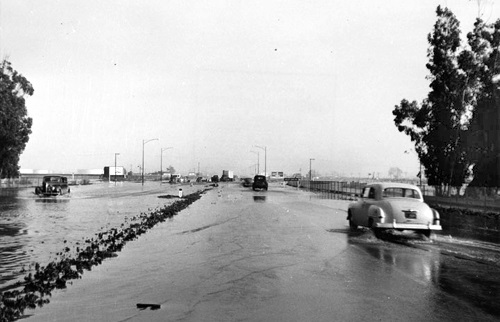 Even modest rainfall could flood Lakewood in the 1950s.
In response, the Army Corps of Engineers confined the Los Angeles and San Gabriel rivers in concrete walls, and built 470 miles of flood control channels, 2,400 miles of underground storm drains, four reservoirs, six major dams, and more than 22 smaller flood control structures.
L. B. Harbour, a construction manager during the building of Lakewood, recalled many years later, “A big part of the (Lakewood Park) project was flood control,” which was solved by a network of open, unlined ditches. “We put them in ... And without them, the land would not have been eligible for development.”
New threat
In 1987, the Army Corps of Engineers determined that the Los Angeles River flood control system would no longer contain the runoff from a “100-year storm.” Because of the renewed threat, the Federal Emergency Management Agency proposed placing ten southeast cities, including a large part of Lakewood, in a “flood hazard” zone. The designation would require homeowners to get costly federal flood insurance.
Lakewood city officials reacted with a mix of lobbying efforts, community education, and technical studies.
The city paid for a survey showing that 5,000 of the 13,000 properties in the proposed flood hazard zone in Lakewood were exempt from insurance requirements because they were actually above the level of potential flooding. That saved Lakewood property owners approximately $10 million in future flood insurance premiums. The city also held workshops to help residents learn about federal flood insurance requirements. Meanwhile, city officials met with federal agency representatives and members of Congress to urge quick action to restore flood protection.
To end the threat, the city joined with other communities in the hazard zone to push Congress to fund flood protection restoration along the Los Angeles River. They succeeded. When the project was completed in December 2001, flood protection was restored and flood insurance requirements were eased.
Edward Bouton, like so many newcomers to Los Angeles in the late 19th century, was a Civil War veteran. He had served as an artillery commander in General William T. Sherman’s army in Georgia.

Edward Bouton (shown in 1896), was a rancher, banker, railroad speculator, and real estate developer.
Bouton planned to profit during the real estate boom of 1887-1888 by building a speculative townsite on Cerritos Rancho property he had recently purchased. He laid out a plan for homes and farms roughly east of what is now Cherry Avenue and north of Carson Street. The real estate boom abruptly ended, and Bouton’s subdivision was never officially recorded and was never built.
Bouton drilled for water on his land to supply his own needs and neighboring farms. Water – in the form of flowing artesian wells – was already being tapped on land nearby, giving Bouton confidence that he would strike water on his own property. Bouton brought in his first producing well in 1893.
A spectacular new well in 1895 was a "genuine gusher." When Bouton’s driller hit water, it was reported that the roar of the blast could be heard miles away. The water pressure was so great that it nearly ripped a two-inch-thick iron cap from the wellhead. For days, the jet of water stood 80 feet feet above ground, like an enormous fountain, gushing 2,300 gallons of water a minute. Special trains from Los Angeles brought gawkers to watch the spectacle. Local papers said the column of water, shining in the afternoon sun, could be seen from as far away as Whittier.
The overflow from Bouton’s well enlarged a seasonal marsh until it covered more than 200 acres. The well initially yielded about four million gallons of water per day. But by 1903, the well flowed at the rate of 823,000 gallons per day, a decrease of 80 percent.
The marsh shrank in the following years to became several smaller ponds. The largest of these was expanded by Thomas Stovell, superintendent of the Bouton Water Company, and became Bouton Lake. This was the site in the early 1900s of the Cerritos Gun Club.
Drought years after 1915 lowered the water table and ended production from free flowing artesian wells. When Clark Bonner began development of Lakewood, Bouton’s townsite and his wells were only memories. The building of the Lakewood golf course in 1933 replaced Stovell's lake with a meandering water hazard that took the name Bouton Lake.
Professor Christopher C. Sellers, writing about the landscapes of the Los Angeles Basin before the advent of humans (at least 13,000 years ago), noted that the basin’s plant life had adapted uniquely to wide variations of altitude, rainfall, and soil:
Unlike in much of the east, forests made up only a small share of Los Angeles’ plant cover. The basin flats sprouted a California version of prairie, with low-growing grasses and other non-woody plants and wild flowers. Along the basin’s elevated edges, the prairie shaded into chaparral, a diverse scrubby growth dominated by species such as the needle-leaved chamise (Adenostema fasciculatum) and the manzanita (Arctostaphylos), with striking red and orange branches, along with the California lilac or Ceanothus, purple and fragrant in bloom. Along the coastal foothills that became known as the Santa Monica Mountains, the chaparral thinned out into the scruffier, thinner vegetation of the sage coastal scrub. Valleys like those around the San Gabriel River sprouted … savannas interspersed with mature oaks, sumac, and other smaller evergreens. Further up, yellow pines and incense cedar [dotted] the mountain canyons and crags. Isolated from other parts of the continent by mountains and desert, the basin, along with the rest of Southern California, evolved an unusual number and range of native plants and animals that were found nowhere else. Small wonder that its less tended lands stirred eastern reportage of a "delightful strangeness on every side." Twentieth-century biologists would declare it a continental "hot spot" of bio-diversity.