Lakewood shocked the staid world of local government in 1954. The effects multiplied throughout California. Today, more than a quarter of all California cities are 'Lakewood Plan' cities.
Only days after the election that incorporated Lakewood as the nation’s first “city by contract,” Los Angeles County Counsel Harold Kennedy wavered in his support of contracting. Because the new city had no fiscal reserves and would not collect any property tax revenue for nearly a year, Kennedy believed that the county would be acting illegally if it continued services in Lakewood.
City Attorney John Todd vividly remembered the tense days that followed Kennedy’s announcement:
On March 16, 1954, I outlined in a letter to (County Supervisor) Herbert C. Legg the proposal by the five councilmen-elect of the city of Lakewood that the city of Lakewood contract with the county for performance of municipal services. Although we had been assured by county department heads and other county officials that the county could and would contract with us, I was shocked to receive a telephone call from County Counsel Harold Kennedy advising me that he did not feel the county could contract with us in that the city would not have any means to pay for these services.
He placed his objection on the fact that the city would not be collecting taxes for a period of almost one year. But I protested that the city would have other sources of revenue such as business licenses and other funds. Mr. Kennedy said, however, that we had to be in a position whereby we could levy taxes at this time before the county could contract with us, otherwise it would be “a gift of public funds.”
I was shocked. All of our plans would now go down the drain. All of our planning and work were lost by what appeared to me to be a very arbitrary decision.
Apparently, no one in the county counsel’s office had been properly briefed of our plans or county officials must have felt that the movement would not succeed. At least, no one had ever communicated to us their feelings.
This indeed was one of my darkest moments. I contacted Lee Hollopeter. He called me back shortly thereafter and told me to call Herb Legg and demand immediate action. At this point, I wasn’t thinking too nicely of Herb Legg because I felt that someone might be trying to defeat our successful incorporation. I still had deep wounds and scars from the battle with Long Beach.
I did what Lee Hollopeter suggested. Herb seemed upset and protested my attitude. Looking back on that day, I believe that Herb was probably an innocent victim and had not done anything to destroy the movement.
The result, however, was that the next day the Board of Supervisors sent me, Hal Kennedy, Gene Nebeker, Angelo Iacoboni, and a special attorney we retained to Sacramento to obtain special legislation whereby the (Lakewood) City Council could enact a property tax, which would be retroactive to February 1, 1954.
 Governor Knight (surrounded by the city council) signs legislation allowing Lakewood to receive tax revenue to pay for county contract services in 1954.
John Todd had conceived the contract city plan. Now, his plan seemed to be coming apart. Without county contracts, the new city of Lakewood would open for business in April only to tell residents that they had no law enforcement, trash collection, street sweeping, or any of the other services they wanted and needed.
It was essential that Lakewood’s new city council members make a case for Lakewood’s future to the Legislature in Sacramento. They did.
A few days later, Lakewood residents waited for word that state legislators, despite opposition from some cities with annexation ambitions, had voted to give Lakewood its share of property tax revenue ... and a future.
With the help of a majority of sympathetic legislators, Lakewood received almost $500,000 to pay for infrastructure improvements in 1954-1955 and got the authority to receive property tax revenue retroactively to the beginning of 1954. Lakewood would have enough revenue to pay for county service contracts when city hall opened for business on April 16, 1954.
The first contracts with the county were simple. For example, sheriff’s law enforcement services were provided in exchange for the new city’s court fines and forfeitures with no additional charge to the city.
 Lakewood had only four employees in 1954. John Todd (left), Guy Halferty, Nita Birch, and Robert Anderson are standing.
It wasn't just cost savings. The first months of contracting showed another positive side to the Lakewood Plan – its flexibility. The Sheriff’s Department in 1954 didn’t enforce traffic laws in unincorporated areas of the county. The California Highway Patrol did. But the commander of the Highway Patrol didn’t like the idea of contracting. Faced with this new uncertainty, the Sheriff’s Department immediately agreed to provide traffic enforcement in Lakewood, the first of dozens of innovative solutions to Lakewood’s law enforcement needs.
Lakewood had become the nation's first “city by contract,” and that fact, coupled with the city’s phenomenal growth between 1950 and 1954, generated enormous media attention. Suburban communities in Los Angeles County even newer than Lakewood began to see in contracting the means to preserve local authority without the huge expense of establishing stand-alone police departments, building divisions, or sanitation units.
Besides, said many in local government, why should an increasingly urbanized Los Angeles County be run like a collection of rural towns? In an urbanized county, why shouldn’t cities turn to a regional service provider like the county to give them services at a cost lower than they could provide themselves? (A closer look at Lakewood's relationship with the Los Angeles County Library)
The logic was compelling, and Lakewood wasn’t alone as a contract city for very long. By 1960, the principle of municipal contracting had led to several more incorporations in Los Angeles County, turning square miles of tract houses into new cities. By 2003, fully a quarter of California cities – and not all of them new suburbs – were contracting for all or most of their municipal services under variants of the Lakewood Plan.
Lakewood’s innovation in local government coincided with the transformation of Los Angeles County from an agricultural empire into the nation’s largest and densest urban region. Post-war migration into Southern California had boosted the population of unincorporated areas of the county from 444,741 in the 1940 census to an estimated 1,150,570 by 1954.
 Lakewood's principal service provider was -- and remains -- the County of Los Angeles.
Even though the county was growing in population, the boundaries of its few municipal governments had stayed largely the same. No new city had incorporated in Los Angeles County since 1939. Of course, the new suburban communities wanted “home rule,” but incorporation elections had repeatedly failed before 1954 because of the large capital investment needed for even modest city facilities.
There had been talk in the 1930s that regional government based on “the Dade County experiment” might satisfy the needs of unincorporated communities in Los Angeles County. Dade County, Florida (which includes Miami) had a long-established form of government that provided some municipal-type services to cities through regional agencies.
The attractions of the “Dade County experiment” were mostly lost on Los Angeles County residents, perhaps because they remembered earlier proposals for creating a vast City-County of Los Angeles. While consolidation as a combined city-county might have been efficient, a regional government centered in downtown Los Angeles didn’t appeal to residents in suburbs far from the power brokers and media empires that dominated Los Angeles politics.
The contract city form of municipal government became the preferred model in Los Angeles County. It was not a completely new form of government, because contract cities retained the same city council structure and home rule authority common to all cities in California formed under “general law” principles. (General law cities are created through provisions in state laws for incorporation. Charter cities are created by the Legislature’s adoption of a city charter.)
The benefits of contracting for service even came to older cities that had other traditions. Contracting displayed its flexibility when those cities sought new ways of providing services.
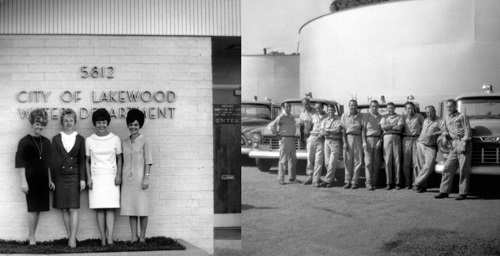 Water operations became a city division with the purchase of the Lakewood Water and Power Company in 1959.
Long Beach in the 1980s contracted with the Los Angeles County Sheriff’s Department to patrol a portion of the city while the Long Beach Police Department reorganized. Compton, which had its own police department, began contracting with the Sheriff’s Department as well.
Experimentation led to other choices. Downey, which incorporated as a contract city, eventually gave up sheriff’s law enforcement and established its own police and fire departments. Santa Fe Springs severed its relationship with the Sheriff's Department and contracted with the Whittier Police Department for law enforcement services.
What is familiar to city professionals is still controversial, however. In the 1960s, newly incorporated communities under the Lakewood Plan were branded by their critics as “phantom cities” or “minimal cities,” even though their city councils provided the same level of service that non-contract cities did.
Today, some in the academic community continue to view contract cities negatively. Contracting, in their view, has been a disaster, hastening the decline of big cities, encouraging “white flight,” and magnifying competition among a proliferation of sales-tax-dependent local governments. Advocates of regional government view the state’s 425 cities as roadblocks for carrying out region-wide policies for housing, transportation, and economic development.
The millions today who live in Lakewood Plan cities have a hard time recognizing their hometown in such a bleak assessment. Contract cities pioneered the concept of regional government through strong counties. And contract cities are among the most efficient users of taxpayer dollars in California.
Every California city today contracts for something. City-to-city contracting, special districts, joint powers authorities, and regional associations have been added to the basic formula of contracts for law enforcement, engineering, and infrastructure maintenance.
It can be said, in a sense, that every California city is partly a contract city now.
 Flexibility to provide the best service at the lowest cost is the principal strength of the Lakewood Plan.
There were four elements important in the expansion of the Lakewood Plan in the 1960s:
- Los Angeles County had a history of providing municipal-type services to unincorporated areas and had been expanding the level and number of these services as the county became more urbanized. By 1950, the county was directly or indirectly providing services to 45 communities in the county.
- The success of Lakewood’s incorporation proved that contracting was both feasible and effective.
- The California Legislature adopted the Bradley-Burns Uniform Sales Tax Act. As Charles Waite, writing for the Falk Foundation in 1957, noted: "During the 1955 session of the Legislature of the State of California, a very significant bill was passed … (which) in essence allows counties in the state to levy a one per cent sales tax in all unincorporated areas of the county. Ostensibly, the bill's purpose was to create a uniform 4% tax throughout the state (3% state plus 1% local). The effect of the bill was the one spark that the move for incorporations needed. Although cities could levy a sales tax prior to the passage of the bill, this was never quite enough incentive to start a wave of incorporations. Since the new measure, however, allowed the County to collect a sales tax which would be put in County coffers and was not under the control of the residents of the particular County area in which it was collected, communities were spurred to incorporate and retain this money in their own local treasuries."
- The county was a willing partner in incorporation, seeing cityhood under the Lakewood Plan as a way of strengthening county departments and financing innovations that would benefit the entire county.
 Street sweeping is a service provided by private industry under contract with the city.
The early success of the Lakewood Plan was the subject of reports in The New York Times, Time, Newsweek, and even the Harvard Law Review, which called the Lakewood Plan “the most significant undertaking involving the transfer of service functions in the United States.”
Within five years of Lakewood’s incorporation, 19 more cities began as Lakewood Plan cities, with six incorporations over the following year. These early contract cities included Dairy Valley (now Cerritos), 1956; Downey, 1956 (the only city to leave the contract system in its first years of existence); La Puente, 1956; and Bradbury, Bellflower, Duarte, Industry, Irwindale, Norwalk, Paramount, Rolling Hills, Rolling Hills Estates, and Santa Fe Springs, all in 1957.
A year later, the cities of Pico Rivera and South El Monte incorporated as Lakewood Plan cities. Artesia, Lawndale, Rosemead, and Walnut joined them in 1959. And Bell Gardens, Commerce, Cudahy, La Mirada, San Dimas, and Temple City were incorporated in 1960.
As the number of Lakewood Plan cities grew, the resentments of some older cities also increased. They claimed that their taxpayers were subsidizing a “free ride” for contract cities because, they said, contract cities didn’t pay 100 percent of the county’s costs for each contract service.
In 1957, the California Senate Committee on Metropolitan Areas held hearings on the “free ride” charge but produced no evidence of subsidized services for contract services.
The conflict seemed to be about different models of cost recovery, but underlying the conflict was a clash over the sales taxes and property taxes generated by new development in unincorporated areas. If these areas incorporated, adjacent older cities feared they would be left out of the revenue boom.
The next challenge to contracting came unexpectedly from Los Angeles County itself. Under the first Lakewood contract, sheriff’s patrol services were reimbursed by court fines and forfeitures. The cost for a 24-hour, seven-day-a-week patrol car was just $78,400 a year. In 1960, the county Board of Supervisors proposed a 25 percent cost increase, boosting the cost of a patrol car to $104,533 a year. Locally collected fines and forfeitures would no longer be enough to pay for law enforcement.
 Law enforcement was the first and largest of Lakewood's county contracts in 1954.
The new costs set the stage for a major confrontation between the county and Lakewood Plan cities.
The new cities, including Lakewood, hired an auditor to review how the Sheriff’s Department had calculated the proposed increase in service costs. The cities brought their findings before the county's Civil Grand Jury. The grand jury recommended an improved accounting system for setting law enforcement costs that remains basically the same today.
But non-contract cities continued to object that Lakewood Plan cities were getting a “free ride” under the new accounting system. Some officials in non-contract cities claimed that Lakewood Plan cities weren’t really cities at all, but only fronts for county government.
Disagreements continued to simmer even as the number of Lakewood Plan cities increased.
Not all conflicts over contracting came from Los Angeles and other big cities. As more new cities joined those operating under the Lakewood Plan, council members learned that not all contract cities were getting the same deal from the county. Some contract cities got higher levels of services than others. Some were charged a higher rate for the same service. And some got county funding that not all contract cities received.
As the California Contract Cities Association wryly noted, “The terms of any given contract depended, it seemed, on how good a bargainer any given city might be or how important it was to the county to maintain a contract (for street sweeping, for instance) to hold the line against inroads by private competitors …”
Lakewood Plan cities turned to joint action to resolve these issues, forming the California Contract Cities Association in November 1957. The founding members were Lakewood, Bellflower, Duarte, La Puente, Norwalk, Paramount, Rolling Hills, and Santa Fe Springs.
With lobbying campaigns in Sacramento and legal battles in the courts, the state's Lakewood Plan cities, the county, and non-contract cities fought over the meaning of independence, local control, and cost recovery. Eventually, state legislation was passed that required the county to charge Lakewood Plan cities for all the costs incurred as a result of contracting, including overhead costs but only those overhead costs that are directly attributable to the service.
In early 1974, the Los Angeles City Council filed a suit challenging the constitutionality of the legislation. To deal with this new challenge, Lakewood Plan cities turned to a committee of city attorneys under the chairmanship of Lakewood City Attorney John Todd.
 Fire and paramedic services are not contract services in Lakewood. They're provided through a countywide Fire Protection District.
Todd and his committee won the case for contract cities in Superior Court, in the state Court of Appeals when Los Angeles appealed the Superior Court decision, and ultimately won in the California Supreme Court.
Lakewood Plan cities would pay the direct cost of providing services and their share of the county’s overhead costs for providing those services, but they would not pay more.
Urban theorists into the 2000s insisted on seeing Lakewood as a deficient place, rather than as a dynamically changing community whose residents were making up new rules of self-government as they went along. John Keats in The Crack in the Picture Window condemned suburbs like Lakewood as a "jerry-built, homogeneous, post-war Hell.”
When the critics considered the success of the Lakewood Plan, they tended to be equally skeptical. Lakewood was called a “partial service city” because it didn’t have its own police department or fire department. As contracting gained popularity among professional city managers, contracting’s value as a tool for community building was discounted by some academics because the Lakewood Plan didn’t meet their tests for authenticity and social equity.
Not all academic studies of Lakewood’s experience in community building yielded negative images of the city and its residents. In the early 1960s, economists Vincent Ostrom, Charles Tiebout, and Robert Warren described Lakewood’s sense of place as arising from the collective choices of its residents. The city’s success, they argued, came from the ability of its residents to evaluate their public needs – law enforcement, recreation, neighborhood quality of life, etc. – and to mutually provide for them from whatever sources made sense to them as Lakewood residents. This analysis emphasized that Lakewood residents were (and are) actors in their own story, not mere subjects of external social and economic forces.
Elinor Ostrom (the wife of Vincent Ostrom) elaborated these themes in a long career that culminated with the Nobel Prize for Economics in 2009.
Despite it's popularity, the Lakewood Plan continues to be the target of legislation that would put, as one official of a contract city said, “a dagger through the heart of contracting.” Anti-contracting legislation usually contains a number of “daggers,” including elaborate cost analyses required to justify new contracts, a ban on contracting for services currently performed by city employees, restrictions on the use of personal service agreements, and an open-ended invitation for public employee advocates to sue city officials to prove that contracting outweighs the public’s interest in having city employees perform the job.
 The California Legislature has repeatedly tried to limit the capacity of cities to contract for services.
For their part, advocates for regional government contend that contracting made cityhood too easy and led to political fragmentation and reluctance to undertake region-wide initiatives to solve regional problems. Amalgamation of existing cities into large metropolitan regions – a model followed in Britain, Australia and New Zealand – continues to be the goal of some state legislators.
Many public policy critiques since 1960 have insisted that contracting encouraged the decline of older cities and the flight of middle-class residents from racially mixed urban centers. Other policy studies have praised contract cities for their "small government" principles. There have been only a few studies of contract cities that measure the cost and quality of their municipal services against those of non-contract cities.;
Was Lakewood in the 1950s and 1960s the hokey, TV sitcom world of Leave It to Beaver or The Brady Bunch? Was it a sham city, without the authenticity of a real municipality and little more than a vehicle for sending sales tax revenue to county agencies? Was it an enclave of Anglo suburbanites with their backs turned on Blacks, Latinos, and Asians?
Was Lakewood, as one commentator put it, ultimately doomed by cut backs in federal defense spending after the collapse of the Soviet Union in the 1990s?
Most Lakewood residents would have been puzzled by these questions, and some would have been offended by their implications. Lakewood residents generally understood what they had gained and lost in making Lakewood their home.
There is a wide and troubling gap between what the scholarly literature says about Lakewood and what Lakewood residents say about themselves. It’s a gap still to be filled by newer and more realistic studies of the city and its residents.
Lakewood’s role in the creation of so many California cities did not guarantee that Lakewood’s unique place in history would be remembered. Today's residents of contract cities seem to be hazy about the form of local self-government under which they live.
Contracting, to them, is just part of the anonymous background that supplies municipal services.
The lack of interest is, ironically, a measure of the Lakewood Plan’s success in providing lower-cost, efficient government services. In a sense, Lakewood officials today can boast that nearly all Los Angeles County cities are at least partial Lakewood Plan cities.
 The contract model offers cities values beyond lower-cost services.
For example, all but a few cities in Los Angeles County participate in the county run Fire Protection District. While not a contract service, the fire protection and paramedic services provided through the county mean that a county department is responsible for what are traditionally local public safety programs.
Might Lakewood voters have chosen in 1954 to provide municipal services in the conventional way? No one can be sure about that “what if,” but service contracting in 1954 was clearly born out of necessity. Contracting also had the advantage of newness in a community prepared – eager, in fact – to embrace what was innovative.
And residents in 1954 were satisfied with the quality of the county services they were already getting. Incorporation didn't change who swept the streets or patrolled them either.
In 1995, the California Taxpayers Association reaffirmed its support for competitive municipal service delivery by noting, “contract cities in California, generally cities incorporated in the last twenty years, regularly deliver services at less than half the cost of more established, older jurisdictions.”
Once a revolutionary form of municipal organization, the Lakewood Plan is now part of every city’s tool kit for delivering services.
In October 1937, Los Angeles County Librarian Helen E. Vogleson noted that discussions were taking place regarding the creation of a county library branch to serve the residents of Lakewood Village. Library service began in January 1938 with the opening of a small, storefront library, housed in a 650-square-foot storeroom at 4152 Los Cerritos Diagonal (now Norse Way). The library lease was $26 a month. There were 1,218 books in the collection.
Jayne C. Hathcock was Lakewood’s first librarian and she and the Lakewood Village branch served not only the residents of Lakewood Village but also the students who were now attending Long Beach Junior College (later Long Beach City College), which had opened its new campus at its present location at Clark Avenue and Carson Street in 1935.
 Lakewood's first library opened in 1938 in a converted storeroom on what is now Norse Way in Lakewood Village.
Hathcock’s tenure as librarian was short-lived, however, and she was replaced in 1939 by Minnie O’Toole, who was in turn succeeded by Thelma Bailey in 1943. By the time Nola Vredenburgh was appointed librarian in 1944, six years after the opening of the branch, it was clear that the library had outgrown its small space. An addition to the building at Los Cerritos Diagonal was constructed and a greatly expanded library reopened in its original location on May 10, 1945.
The rent of the Los Cerritos Diagonal storefront had risen to $140 a month in 1952, when Mildred A. DeLay replaced Vredenburgh as librarian. By 1953, when Violet Bly succeeded DeLay, it was clear that in spite of expanded library hours and the addition of bookmobile service, the Lakewood Village branch was no longer adequate to serve the residents of Lakewood. The small village of the late 1930s had turned into the biggest subdivision in the United States.
A storm was brewing, however, and the years 1953 and 1954 would prove to be watershed ones, for both Lakewood and the library. On March 9, 1954, Lakewood residents voted in favor of incorporation by a 2,600 vote margin and Lakewood, with an estimated population of 71,000, achieved cityhood under the “Lakewood Plan.” The plan allowed Lakewood to retain local control of its government while contracting with Los Angeles County for existing services and remaining in existing special districts, like the county library district.
Indeed, one of the resolutions passed by the first city council, who met for the first time on April 16, 1954, was Resolution 37 requesting that Los Angeles County provide library service to the new city. Librarian Virginia Wertz supervised the opening of a new (but temporary) 1,600-square-foot branch library in the Faculty Shops on January 3, 1955. It would serve as Lakewood’s library until the planned city-county complex was completed.
The Lakewood Civic Center was dedicated on May 15, 1959. The new library at 5100 Clark Avenue, with 6,400 square feet containing 20,000 books and space for 15,000 more, was the largest in the Los Angeles County system at the time. In charge of the new facility was Letha Gramer, who was succeeded by Tom Toomey in 1962, under whose tenure Lakewood’s first children’s librarian, Marian Solace, was appointed in 1963.
Circulation for the first year of service of Lakewood’s civic center library was 123,454 but it more than doubled to 273,000 the following year, and in 1962, the branch ranked number one in circulation in the entire Los Angeles County Library system. By 1964, more than 300,000 books were being borrowed through the Lakewood library each year.
 Head Librarian Helen Amestoy oversaw the expansion of county library services through the 1970s and 1980s.
Sadly, this was also the year that Angelo Iacoboni died suddenly, and in 1965, the Lakewood City Council voted to rename and rededicate the library in honor of Lakewood’s first mayor. The May 8, 1965 rededication ceremony included Mrs. Gloria Iacoboni’s unveiling of a bronze bust of Mayor Iacoboni. Designed by Alice Littig Sims, the bust remains in the library to this day.
October 1968 saw the appointment of Helen Amestoy as head librarian, and by 1969, a mere ten years after the opening of what was then the-largest library in the Los Angeles County system, it was clear that the library was no longer adequate to meet the needs of the Lakewood community. In June 1969, the Board of Supervisors approved a proposal for a new structure on Clark Avenue to replace the existing Angelo M. Iacoboni Library.
The new building, which would boast 24,500 square feet and be designed by the architectural firm of Williamson, Morris and Paige, was constructed for the contract cost of $658,400. Also in the works was the construction of the George Nye, Jr. Library, named for one of Lakewood’s city founders and the mayor of Lakewood when he died in office in 1971.
In February 1973, the George Nye, Jr. Library with Linda Saferite in charge, opened to the public.
 The remodeled Iacoboni Library opened in 2001 with technological upgrades.
The following month saw the reopening of the Angelo M. Iacoboni Library in its new location south of city hall. With a combined total of more than 100,000 volumes for both libraries and with the Iacoboni Library designated as both a federal depository library (1970) and a state depository library (1973), Lakewood’s libraries continued to adapt to the needs of the community.
The turn of the century brought change once again with the renovation of the Iacoboni Library, a result of the combined efforts of Fourth District Supervisor Don Knabe, the City of Lakewood, and the County of Los Angeles Public Library. The Iacoboni Library reopened on February 12, 2001 with a redesigned interior, technology upgrades, and a Friends of the Lakewood Libraries bookstore.
In looking at the long history of the Lakewood libraries, we are presented with a reflection of the city itself. Just as Lakewood grew from farmland to village to city, so too did the library grow from a storefront branch in 1938 to the Lakewood libraries we know, use, and love today.
By Jennifer Jeter, Angelo M. Iacoboni Library