Public safety is a core Lakewood value, best expressed by the devoted service of sheriff’s deputies, firefighters, paramedics, and public safety volunteers.
Lakewood’s decision to contract with the Los Angeles County Sheriff’s Department and remain a member of the countywide Fire Protection District profoundly changed both of these agencies, driving each to reshape its mission as a regional service provider. The greatest change came to the Sheriff’s Department, which became the largest local law enforcement agency in the nation as cities adopted the Lakewood Plan of contracting for municipal services.
The concept of law enforcement by contract proved so successful that today nearly half of the 88 cities in Los Angeles County have contracted with the Sheriff’s Department for law enforcement services.
The Sheriff’s Department also had to take on non-traditional roles after 1954, including traffic enforcement. In 1966, deputies took to the air. Lakewood became the first city in the nation to fly regular helicopter patrols through the city’s Sky Knight program.
 The Lakewood Sheriff's Station opened in 1959 in the Lakewood Civic Center.
Lakewood and law enforcement have meshed particularly well, with the result that the city has expanded crime prevention programs, strengthened crime suppression teams, and used grant funding to bring Lakewood law enforcement into the digital era with closed-circuit video surveillance and automatic license plate recognition systems.
For the commanders of the Lakewood station, the city’s relatively low level of serious crime is vindication of the Team Lakewood concept for community-oriented policing.
In 1996 and 1997, the city secured additional funding to expand law enforcement staffing. Lakewood also won a three-year federal grant to set up the station’s Career Criminal Apprehension Program to track criminal activity.
The city also poured funding from the Citizens Option for Public Safety program and the federal Local Law Enforcement Block Grant Program into targeted crime suppression. These funds set up special enforcement units and funded a dedicated traffic safety patrol car. The program has expanded with a second dedicated traffic unit.
Lakewood’s law enforcement team grew to include the city’s PAVE (Partnership, Accountability, Visibility, and Enforcement) program, Lakewood Volunteers on Patrol, nearly 400 Neighborhood Watch block captains, the participants in Lakewood Auto Watch, merchants in Lakewood Business Watch/Mall Watch, property managers in the Lakewood LAND (Lakewood Apartments Nuisance Deterrent) program, the school-based STAR (Success Through Awareness and Resistance) drug and gang education program, and the Lakewood Park Watch program.
In 1956, the city began a youth safety program, developed by the city council, the city's Traffic and Safety Commission, and the Los Angeles County Sheriff's Department. Still offered through local schools, the program focuses on pedestrian safety for children in kindergarten to the third grade. For older students, the program emphasizes bicycle safety.
The city continues today – as it did in the 1950s – to employ crossing guards on at busy intersections. Parents are aided with route maps and safety information to give students a safer walk or bike ride to school.
 Lakewood's crossing guards are part of the city's safety program.
The strength of community-oriented law enforcement lies in the effectiveness of each of its components working in cooperation with the others, an achievement best demonstrated by Lakewood’s Special Assignment Officers (SAOs).
Unlike deputies in patrol cars, SAOs are targeted in response to changing crime patterns. When auto thefts take an uptick, SAOs target early morning car thieves. When residential burglaries show an increase, SAOs work the links between drugs, burglaries, and gangs.
This flexibility allows SAOs to make more arrests and make them stick, because they have the time and resources to study crime patterns, follow leads from Neighborhood Watch and Business Watch/Mall Watch members, and make contacts in the region’s criminal element.
SAOs also go after armed robbery suspects, drug dealers, fraud and identity theft suspects, and other con artists.
SAOs meet quarterly with county parole officers to help monitor those who are paroled in the Lakewood area.
 Lakewood's Special Assignment Officers focus on changing crime patterns.
An SAO also serves on Lakewood’s Nuisance Property Abatement team. For the deputy assigned to the abatement unit, it’s not merely a question of property maintenance but also of crime suppression.
“Lakewood’s property abatement team often reveals cases of drug sales and elder abuse,” noted SAO Deputy Bruce Cantley. “Someone in the household has turned it into a drug house, or an out-of-town landlord had rented to drug dealers. When we begin the abatement process because of maintenance problems, we’re also responding to a source of criminal activity in the neighborhood. When we clean up the house, we also help clear out the crime problem.”
The partnership of deputies and city-sponsored safety programs also secures Lakewood's retailers. Video surveillance and automatic license plate recognition systems at the mall have given mall deputies new tools to suppress crime.
The city also funded the deployment of a fingerprint technician. Lakewood is one of the few cities where law enforcement routinely lifts prints from non-violent crime scenes.
In 2006, Lakewood cracked down on violators who sell or use illegal fireworks. The city also took a strong anti-illegal fireworks message to the community in a coordinated public education campaign.
Lakewood’s Resource Command Vehicle became fully operational in 2007. The vehicle – an Emergency Operations Center on wheels – is equipped with a dispatch center, conference rooms, a satellite telephone communications system, radios linked to other emergency services, and computers to handle a full range of emergency and special event coordination tasks.
Learn more about the city's public safety programs here.
Lakewood’s public safety programs grew after the Lakewood station opened in 1959, but the basic infrastructure of the station had hardly changed by 2003. Time had taken a toll on everything from the station's electrical systems to its plumbing.
To bring the Lakewood station into the 21st century, the city and Los Angeles County Supervisor Don Knabe worked out an agreement to pour $9.4 million in county funds into an expansion and renovation project.
 The expanded Lakewood Sheriff's Station opened in February 2008.
The centerpiece of the project is a new, two-story structure that tied the station’s existing buildings into a single, more efficient unit. This created a larger lobby for station patrons and additional office space for detectives and deputies. The expansion project more than doubled the station’s size.
The station improvement project was completed in February 2008 without a new tax, a tax increase, or special assessment. The project also was completed on time and under budget. Under the city/county agreement, Lakewood acted as the design and construction supervisor for the expansion project.
Today, deputies from the Lakewood Sheriff’s Station patrol Artesia, Bellflower, Hawaiian Gardens, Lakewood, Paramount, and the unincorporated neighborhoods of Cerritos and Long Beach.
By far the largest volunteer component in Team Lakewood is the much-honored Lakewood Neighborhood Watch Program, begun in 1981 and one of the largest Watch organizations in Southern California.
Neighborhood Watch block captains have access to crime prevention seminars, crime statistics in the Watch Briefing newsletter, and the support of the PAVE program’s deputies. They also have access to the city's crime prevention manager and the crime prevention deputy at the Lakewood Sheriff's Station.
Lakewood Neighborhood Watch block captains are trained to monitor suspicious activity in their neighborhood and report potential criminal activity to the Sheriff’s Department.
 Lakewood has one of the largest Neighborhood Watch organizations in Southern California.
Lakewood residents also staff the Lakewood Volunteers on Patrol program, which trains civilian volunteers to patrol the city’s parks, schools, and neighborhoods as a deterrent to crime. Some residents have become civilian volunteers at the Lakewood Sheriff’s Station performing a variety of duties.
What city council members and commanders of the Lakewood Sheriff’s Station sought, beginning in the mid-1980s with programs like Neighborhood Watch, was a network of involved stakeholders who would invest in the future of a safe Lakewood.
As one station commander commented later, “The block captains who work with my deputies through the PAVE program, the landlords who have been trained through the city’s LAND program, and the businessmen and women in Lakewood Business Watch/Mall Watch are building the kind of relationships that defeat crime. These volunteers and the city’s specialized crime units are sending a clear signal to the criminal element that Lakewood means to maintain the quality of life in its neighborhoods.”
In 2021 and 2022, the city added new deterrents to crime in the from of an expanded Community Service Officer team and the hiring of a security guard company to patrol Lakewood neighborhoods every night, working in close collaboration with the Lakewood Sheriff’s Station.
Sometimes Lakewood’s law enforcement challenges are deeply personal. The senseless murder in 2002 of Deputy David Powell – a 19-year veteran of the department, a Lakewood patrol deputy, and a Lakewood Award of Valor recipient for heroism – shook the men and women of the Lakewood Sheriff’s Station. Powell died as he valiantly sought to free a female hostage in Artesia.
Saying that Powell’s death had “tested the soul of Lakewood law enforcement,” Lakewood Station commander Dave Fender joined Lakewood city officials in 2003 in renaming the city’s annual community policing award in Powell’s honor.
In 2004, civic leaders dedicated a memorial at the station in honor of Powell and other deputies who had lost their lives serving the community from the Lakewood Sheriff’s Station.
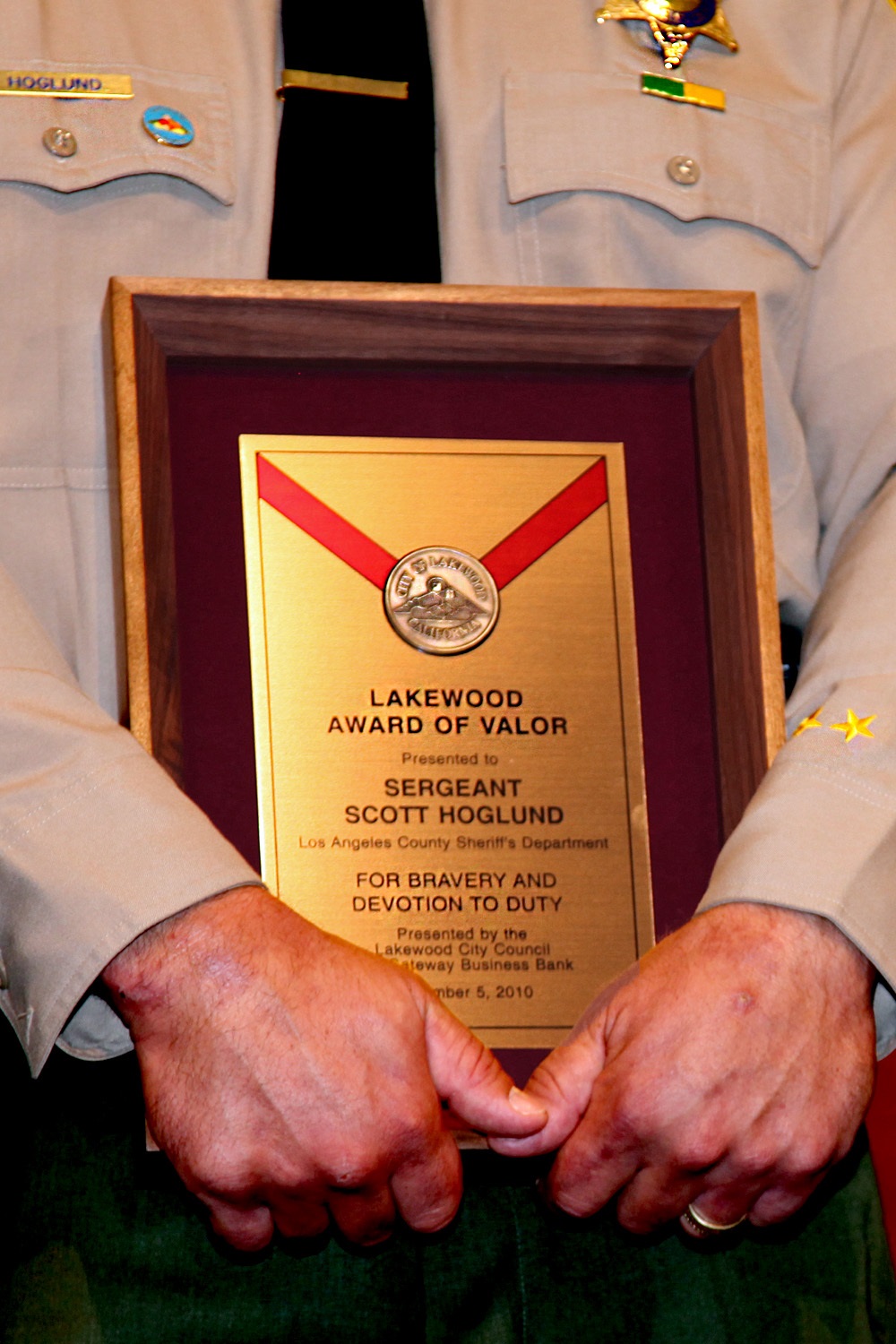
The Award of Valor is presented to public safety officers who responded to life threatening situations with courage and professionalism.
Deputy David Powell’s death defined “devotion to duty and service to others” for Team Lakewood law enfocdmdng, values that the city’s Award of Valor program had begun celebrating in 1980 with the enthusiastic support of then Mayor Paul Zeltner, a former sheriff’s deputy who patrolled Lakewood in the 1950s and who later rose to the rank of captain to command the Lakewood Sheriff’s Station.
Since 1980, the Lakewood Award of Valor has recognized a remarkable range of heroes, including Powell who was first honored for his efforts to save the life of an elderly man in the midst of a suicide attempt.
To earn their Award of Valor, firefighters and paramedics have pulled unconscious homeowners from burning homes, pried open crumpled autos to deliver lifesaving emergency aid, and pulled drowning victims from the icy current in flood control channels.
The Lakewood residents who are Mayor’s Award recipients have chased fleeing suspects, collared strong-arm robbers, helped deputies break up residential burglary rings, faced down armed suspects, and helped save lives with their first aid.
Lakewood’s homes and business are protected by the Los Angeles County Fire Department through Lakewood’s membership in the Los Angeles County Fire Protection District. Often mistaken as a contract service, the County Fire Department is a regional public safety agency governed by the Los Angeles County Board of Supervisors.
While Lakewood does contract for some services from the fire protection district, the County Fire Department is not a contract service in the way the Sheriff’s Department is. (A closer look at Lakewood’s first fire fighters)
 Lakewood's fire fighters and paramedics are members of the Los Angeles County Fire Department.
In 1954, the late Fire Chief Keith E. Klinger joined with other county agencies in support of the Lakewood Plan, allowing incorporated cities to contract with the county for other municipal services while remaining in the county fire protection district.
Today, most cities in Los Angeles County make the County Fire Department their city fire department.
Because the threat of natural disasters is so real in Southern California, Lakewood has invested significantly in disaster preparedness along with the Los Angeles County Department of Public Works, the Los Angeles County Fire Department, and the Los Angeles County Sheriff’s Department.
The Lakewood Sheriff’s Station and Lakewood City Hall have emergency operations centers. Backup electrical generators will keep the facilities in the Lakewood Civic Center up and running following a major disaster.
In 1986, the survivors of the Cerritos air disaster found Lakewood’s disaster team was ready to help. Within six minutes of a mid-air collision that killed 85 persons in the air and on the ground, fire units from Lakewood and surrounding cities had arrived. So fast and massive was the fire department's response, that only those homes actually hit by the downed jet were damaged or destroyed.
While crews from 21 fire units kept the flames from spreading, radio cars from the Lakewood Sheriff's station converged on the scene to cordon off streets.
Lakewood's Sky Knight helicopter was over the crash site in minutes, acting as an airborne extension of the sheriff's command post set up at Carmenita Avenue and 183rd Street.
But Sky Knight's duties quickly turned to aerial traffic management as helicopters from the Long Beach, Huntington Beach, and Anaheim police departments and the Los Angeles County Fire Department arrived on the scene. Eventually, nineteen helicopters – including sheriff and hospital units and news media aircraft – were over Cerritos.
Sky Knight pilot Monica McIntyre was pressed into service as an airborne traffic controller, directing rescue units to landing sites on the ground and keeping news helicopters at a safe distance.
Caring Lakewood neighbors showed up almost as quickly as did disaster workers. With the streets around the crash site closed, Ron Piazza, owner of the McDonald's Restaurants of Lakewood, trucked in more than 2,000 meals and a crew of twelve to feed hungry residents and rescue workers. Other Lakewood businesses provided canned goods, baby care needs, and clothing to those whose homes had been destroyed.
Earthquake preparedness
As early as 1980, the city developed a training program to help family members plan for a disaster. Lakewood residents didn’t have long to wait to put the training to use.
Earthquakes in Northridge in 1987 and Whittier in 1988 taught cities important lessons on the need for family preparedness, more resources for disaster response, better communication with residents, and more neighborhood volunteers as first responders.
 Survive for 7 instructs residents on caring for family members in the wake of a major disaster.
In the 1990s, the city’s Water Resources Department increased the earthquake resistance of its steel storage tanks, added storage capacity with a new reservoir at the city’s Arbor Road facility, and installed auxiliary power if the regional electrical grid is disabled.
In 1995, Lakewood followed the lead of other cities in setting up a low-power emergency radio transmitter to keep residents informed in the event of disaster.
Radio station KLWD-1620 AM has just ten watts of broadcast power, far less than a household light bulb. Still, ten watts of power is enough for 1620 AM to reach the 9.5 square miles of Lakewood from the city’s yard on Arbor Road.
In a disaster, 1620 AM will be Lakewood’s information lifeline with Lakewood-specific information about relief. The transmitter is small and tough and in a protected facility supplied with backup power.
Sky Knight, the helicopter program that has patrolled the Lakewood area since 1966, got an expanded role in disaster response in 1997. With a miniature TV camera and transmitter mounted on the helicopter frame, city officials in Lakewood’s emergency operations center will be able to survey flood or earthquake damage from the air.
For Lakewood residents, the city has created new training programs modeled on the concept of “survive for 7” – the seven-day period during which residents will may have to care for their own emergency needs. Survive for 7 is getting Lakewood neighborhoods ready to deal with disaster when professional first-responders will not be available to help. Lakewood's Survive for 7 campaign was called a model by state disaster planning experts in 2006.
Other Lakewood residents have received even more intensive training in urban search and rescue, pledging themselves to aid their neighbors should a disaster strike.
(1945) The Lakewood Volunteer Fire Department is no more. Beginning today, the Lakewood fire district which includes Lakewood Village, Lakewood City and part of Mayfair, now is part of the county fire district. The volunteers, 19 men who have battled fires in the area, and incidentally have had the time of their lives doing it, from now on will fight fires in an unofficial instead of an official capacity.
It was in 1937 when Lakewood Village was just getting started that the volunteers were organized. They started with one truck, which they bought by giving dances and giving contributions out of their own pockets, and they also had the use of a Montana Land Co. truck.
They built the Lakewood fire station, a frame structure 24 by 24 feet, at 4412 Greenmeadow Rd. They worked out a system of blasts on a huge civil defense air horn to notify members of the volunteer crew where in Lakewood Village the fire was located.
For instance one long and one short blast meant the fire was located in the Lakewood Village business district.
The members got so good at answering calls that often most of them were at the station by the time the second fire truck rolled out.
 Lakewood residents turned out in the early 1950s to see the county's latest rescue and fire fighting equipment.
In 1942, when most of the members were doing war work of various kinds as well as holding their regular jobs, the department was placed under the Public Utility Board. A paid man was kept at the station at night. The equipment was increased to three trucks.
In recent months it has been felt that Lakewood area has "grown up" and needs regular fire-fighting service. As a result the district became included in the county district. The county will keep trained men on duty 24 hours a day, but using the same system of horn blasts the volunteers will answer emergency calls.
"County Fire District Get’s Lakewood Section Tasks,” Long Beach Press-Telegram, July 1, 1945